Part 1 · Aries to Virgo · Navamsa 2
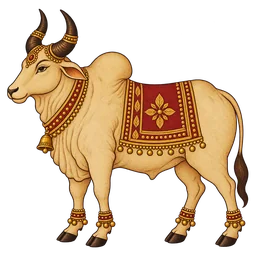
Taurus Navamsa
Vrishabha
The storehouse of the chart; ruled by Venus (Shukra)
The chapter in one minute
- Taurus Navamsa is abundance, not money.
- Aries starts it.
- It is a storehouse, not an income.
- Reward without a fight — so the question is never how hard they worked.
- Spirituality is not the general rule of this sign; practical resource is.
The Navamsa at a glance
- Navamsa
- 2 · Taurus
- Ruler
- Venus
- Element
- Earth · Fixed
- Rises from
- 3°20′–6°40′: Aries, Leo, Sagittarius · 13°20′–16°40′: Taurus, Virgo, Capricorn · 23°20′–26°40′: Gemini, Libra, Aquarius
- Planets at home here
- Moon exalted · Venus own sign
Taurus · sign 2 · the 2nd house of the Kalapurusha
Section A · Who Carries This Navamsa
“Brother, call Nandi. He is bound to have something you can use.”
“I do not need a place for three days. I may have to stay until next week. All my luggage is with me.”
“That is exactly why I am telling you. Just call him.”
The next day, you arrive at Nandi’s house with two bags and a suitcase. He hears the whole problem and thinks for a moment.
Then he opens a room inside the house. It looks less like a room and more like a storeroom for things nobody uses any more.
“Give me ten minutes.”
Nandi begins moving things. A folded mattress emerges from one corner. A sheet and pillow come down from the top cupboard.
He finds a small table his brother left behind. Then comes an old fan. It looks ancient but still runs perfectly.
Then an induction hob appears. A relative left it after buying a new one. There are unused utensils from Nandi’s wedding too.
Half an hour later, the room once buried beneath old possessions has become a place where someone can live.
You ask, “Why have you kept all this?”
The question seems strange to Nandi. “Keep it. Sooner or later, it will come in useful.”
The next morning, you must cross the city. Nandi holds out the key to an old scooter parked downstairs. “Take it.”
“Is this yours too?”
“No. My maternal uncle bought a new one and left this with me. It still runs well.”
Look at the room again. Yesterday, everything appeared useless. Today, those same things have become a bed, a workplace, a kitchen and a means of transport.
Most of them do not even belong to Nandi. Some came from his parents. Relatives left others behind. A few arrived through marriage.
Nandi threw nothing away. He simply kept everything safe until somebody needed it.
The one who carries is usually the one who gets blamed. Find the person in that family who lends, arranges, drives, fixes and holds the papers. When something goes wrong, that is the first name heard in the room.
This is Taurus Navamsa.
Resources enter, remain and slowly form a storehouse. The real question is not only how much this person possesses.
Whose hands brought it—and whose need will it answer when the time comes?
Now notice why this chapter began with a man named Nandi.
The Nandi in the opening scene guarded what others left behind and asked for nothing. In Srimad Bhagavatam, Nandi carries Mahadev and guards Kailasha.
But the one who carries reveals his full nature only when something under his care is threatened.
That test came in a crowded assembly. Daksha entered, and almost everyone rose. Bhagavan Shiva remained seated. Daksha looked at that silence and saw an insult.
The Whole Assembly Rose—Except Two
A great yajna of the Prajapatis was underway.
Brahma ji entrusted the Prajapatis with carrying creation forward. Children, lineages and living beings expanded through them. Daksha was foremost among these guardians of the people.
Great rishis and devas had gathered. Even the presiding deities of the sacred fires were present.
Then Daksha entered, radiant as the sun. His brilliance filled the hall, and everyone rose to honour him.
Two did not rise.
Brahma ji was Daksha’s father and presided over the assembly. He was not expected to rise. The other was Mahadev.
Here we reach the wound from which the whole episode grew. Bhagavan Shiva stands even above Brahma ji. No one there outranked Him.
By position, there was no reason for Him to rise.
But Daksha was not looking at the Supreme Person. He was looking at his son-in-law.
Imagine that a father-in-law manages a company while the son-inlaw owns it. In the office, the hierarchy explains why the owner remains seated.
But the manager enters as a father-in-law first. Suddenly, the same silence strikes directly at his heart.
Bhagavan Shiva was not withholding respect. He belongs to no varna or ashrama. He is a paramahamsa, outside this whole exchange of status.
He sat where He always remained—absorbed within, in Vasudeva. Nothing was being rejected. He was simply not taking part in the transaction.
Daksha could not see spiritual absorption. He saw a personal insult.
Many resentments in Taurus Navamsa begin here. One person remains silent. Somebody else decides what that silence means—and never asks whether he was right.
- 1
And Then Daksha Spoke
Daksha did not let the matter pass.
- 2
Nandi Would Not Remain Silent
Nandishwar is the foremost attendant of Bhagavan Shiva, leader of the Shivaganas and gatekeeper of Kailasha.
- 3
Rishi Bhrigu Answered
Rishi Bhrigu rose with a counter-curse, this time aimed at Bhagavan Shiva’s own people.
And Then Daksha Spoke
Daksha did not let the matter pass. He stood before the entire assembly and turned his anger upon Bhagavan Shiva.
“He lives in cremation grounds,” Daksha said. “He sits among ghosts and spirits, covered in the ashes of burnt corpses. He roams naked, with his matted hair scattered. One moment he laughs; the next he cries. A garland of skulls hangs around his neck.
“He is Shiva—the auspicious one—only in name. In truth, he is the greatest madman among madmen. Only those who have lost their reason worship him.
“And I gave my daughter to this man. At Brahma ji’s instruction, I handed her over—as though the Vedas had been taught to someone unworthy.”
Only after saying all this did Daksha perform achamana.
Achamana is purification before a curse. Daksha touched water so that the words leaving his mouth would follow proper rite. The sequence matters.
The insult came first. Purification came after it. The curse came last.
Daksha touched the water, gathered himself and spoke.
“From this day onward, Shiva will receive no share in any yajna.”
The insult came in anger. The curse came after thought. Achamana stood between them. Daksha paused, composed himself—and then struck.
Bhagavan Shiva did not answer. He remained seated and allowed every word to pass over Him.
The one who was insulted did not speak a single word. Wealth, resentment and settlement—the key to all three is hidden in that silence.
Nandi Would Not Remain Silent
Nandishwar is the foremost attendant of Bhagavan Shiva, leader of the Shivaganas and gatekeeper of Kailasha. He is also the bull who carries Mahadev.
He is the living image of Taurus Navamsa: the one who carries, guards the gate and asks for nothing for himself.
While the matter concerned Nandi personally, he had not spoken. But Daksha had now turned upon Nandi’s Lord.
His eyes reddened with anger, and he began to curse.
The first curse fell directly upon Daksha. Nandi declared that he would lose his grasp of truth.
His Vedic learning would become noise within his own mouth. Soon, he would bear the head of a goat.
Hold the image before you. Daksha, master of the yajna, ends with the head of the very animal offered in sacrifice.
Then Nandi turned towards the brahmanas who had heard everything and remained silent. Those who used learning only to maintain the body would lose all judgement about food. They would beg from door to door and eat whatever they received.
Keep the distinction clear. The goat’s head was Daksha’s curse. The remaining curses fell upon those who heard everything and chose silence.
Nandi himself had not been insulted. The insult fell upon the one he loved. Only that could make him move.
Rishi Bhrigu Answered
Rishi Bhrigu rose with a counter-curse, this time aimed at Bhagavan Shiva’s own people.
Those who took vows to please Shiva would wander outside the shastras. They would live upon meat and alcohol and take shelter in hypocrisy.
Nobody raised a weapon. Nandi condemned the brahmanas to dependence upon alms. Bhrigu corrupted the food of the Shivaganas. Both blows landed upon the mouth.
One curse takes away what enters the mouth. The other pollutes it. Taurus Navamsa guards speech as carefully as it guards food.
Bhagavan Shiva heard it all and said nothing. Saddened, He gathered His people and left the assembly.
Now Read It Like an Astrologer
Taurus Navamsa can bear a personal insult for years. Touch the mother, the family name, the ishta-deva or anything quietly protected, and the bull awakens.
Ask whom the native has cut out of their life completely. It often happened in one afternoon — and it was rarely about an insult to them alone.
Nobody drew a sword in that hall. One sentence brought another, and the damage continued for three chapters.
Remember Rishi Bhrigu. His lineage will return through Shukracharya and take a king’s youth away with a single sentence.
The whole nature of this Navamsa is now before us. It receives, preserves and protects. But everything it stores carries a history.
Five principles are enough to read that history.
The Storehouse—What the Planet Accumulates
Every Resource Has a Giver—and a Price
Touch What It Protects—and the Bull Awakens
Taurus Navamsa
Venus
The Mouth Fills the Storehouse—and Empties It
Venus Is the Seed
1. The Storehouse—What the Planet Accumulates
Aries Navamsa was the battlefield. In Taurus Navamsa, the household begins.
The planet placed here becomes a material resource. It must remain available. When that resource disappears, the person begins to feel poor.
Suppose Mercury is in Taurus Navamsa.
Ask whether the native subscribes to every OTT platform. Then look for credit cards, bank accounts, books, pens, stationery and one online course after another.
There may be so many notebooks and papers that finding space for them becomes a problem.
Change the planet, and the contents change.
With Saturn, expect iron, pipes, a tin factory, scrap, old furniture, frozen food or oil.
With Mars, expect motors, a television showroom, electronic goods or land.
With Rahu, expect SIM cards, electronics, perfume, garments or followers.
With the Moon, expect provisions, medicines and herbs. A property may become a restaurant or bring rental income.
One person stores potatoes. Another fills a shop to the ceiling. Someone else owns rolls of cloth nobody has counted. Taurus Navamsa gathers things and keeps them.
2. Every Resource Has a Giver—and a Price
Taurus Navamsa seldom gives through effort alone. Resources arrive through grace, family, partnership or relationship.
The planet tells you what is being given. Its source in the rashi chart shows the form and the price. The Navamsa house shows whose hands deliver it.
The Moon points to the mother.
Venus or the 7th lord points to the spouse.
The Sun points to the father or a person in authority.
The 8th house points to the spouse’s family.
Jupiter or the 9th lord points to the guru.
The 11th house points to friends and groups.
The 10th house points to profession or the father’s lineage.
Treat the giver with respect. Dishonour that person, and the road through which the resource arrives begins to close.
Behind every rise in fortune stands somebody’s grace.
But grace may carry a bill.
If the planet comes from Virgo, prosperity may bring illness, debt or an old family burden. The same applies to the rashi chart’s 6th, 8th or 12th house.
Suppose Rahu comes from Virgo in the 5th house and enters the 10th house of Taurus Navamsa.
The 5th house is the source. Look towards the paternal grandfather and the mother’s family. Stomach trouble, paralysis or a serious inherited illness may run through that line.
Read the illness before the money. Ask about constipation, diarrhoea or a stomach illness that once brought somebody close to death.
Then ask whether anyone on the mother’s side suffered paralysis. The native may stand within the same hereditary line.
Now extract the money from the same planet.
Virgo is the rashi of debt. Money may therefore come through loans or through work connected with illness. The grandfather may have earned through medical consultations.
The 10th house can show the mother-in-law. She may keep giving the native one thing after another.
She may already have a necklace wrapped and waiting: “I will give it to her when she comes.”
One planet gives illness, lineage, debt, income and the mother-in-law. The gift and its price travel together.
3. Touch What It Protects—and the Bull Awakens
At most times, Taurus Navamsa receives, preserves and enjoys. It becomes fierce when somebody tries to take away its resource.
Aries Navamsa earns on the battlefield. Here, things may come more comfortably through relationship, favour and grace.
But try to take the resource away, and the Parashurama within this Navamsa awakens.
“You touched my family? You did this to my father?”
That resource may be money. It may also be a parent, a spouse, a child, a family name or a deity.
Aries Navamsa threatens one person: “I will show you hell.”
Taurus Navamsa threatens the whole bloodline: “I will put your father, mother, sister and brother behind bars.”
The rashi in the 2nd house of the Navamsa shows the language in which the family is attacked. The rashi in the 8th shows how the attack reaches the spouse.
Dowry is read here too. What entered through marriage? Who was later pressed for money? “What did you bring from your father’s house?” That sentence belongs here.
Nandi did not rise for himself. He rose when Daksha attacked Bhagavan Shiva. This difference prevents many wrong readings.
4. The Mouth Fills the Storehouse—and Empties It
Taurus is naturally the second rashi. The 2nd house governs the mouth: what enters it and what leaves it.
This Navamsa suffers when the person abuses others, disrespects food, breaks their word or speaks endlessly against their own fortune.
When money stops, do not reach for a gemstone first. Ask what the person eats, how they speak and whose company they keep.
No gossip. Give with a willing heart. Speak with love and respect. In Taurus Navamsa, humility is not etiquette. It is part of the method.
Now follow the fixed axis.
Taurus is food and speech.
Leo is the stomach, status and honour.
Scorpio is sadhana and the resentment left by wounded honour.
Aquarius is desire.
A blocked desire in Aquarius may begin as resentment in Scorpio. That resentment may hide a wound to status in Leo. Behind the wound, you may find food or speech in Taurus.
When desire will not move, travel backwards. Ask about resentment, then honour, then the mouth.
5. Venus Is the Seed
Wherever Venus sits in the Navamsa, that is where the money tree has been planted. The harvest follows the care given to that place.
If Venus is in Pisces, money rises as sadhana rises.
If Venus is in Gemini or the 5th house, what is spent upon children and education returns.
If Venus is in Virgo in the 10th house, correction, skill and careful work push the career higher.
Find Venus. Then ask whether the native is feeding or neglecting the ground in which the seed was placed.
The Bull Who Carried Her Away
After that assembly, Daksha arranged a great yajna. Invitations went to everyone except Mahadev and Mata Sati.
Mata Sati saw the wives of the devas passing overhead, beautifully dressed and travelling in the same direction. She went to Mahadev.
“It is my father’s house. A daughter does not wait for an invitation before visiting her own family.”
Mahadev warned Her. “Your father will not even look at you.” An insult from one’s own family cuts deeper than a blow from an enemy.
Nobody sent Her. Mata Sati set out alone, walking quickly.
The Shivaganas saw Her leave and ran after Her in their thousands. Nandi led them. They seated Her upon the bull and gathered everything She loved: Her pet bird, ball, mirror and lotus.
Maniman and Mada followed beside him, with thousands more behind.
A white parasol rose above Her. Chamaras moved at Her sides, and garlands were placed around Her. Drums, conches and flutes sounded before the procession.
Pause over the ball. It was a piece of Her childhood. Those who loved Her remembered even that.
She left alone. They ran after Her, turned the lonely walk into a procession and placed Her upon the one born to carry.
At the yajna, Mata Sati’s mother and sisters came to meet Her. Daksha did not even look at Her.
He did not order Her out. He continued the yajna as though the place where his daughter stood were empty.
Mata Sati looked across the sacrificial arena. Every deva had a seat and a share. Each name was called aloud.
The priests carried every portion to its recipient. Her eyes moved along the entire line, searching for one name.
It was not there. No seat. No share. Not even a token portion had been kept for Her husband.
He had been removed from the ceremony as neatly as a name struck from a list.
Three hundred people sat there. Not one had spoken. Mata Sati remained standing among them, thinking of the one man they had all excluded.
Then Mata Sati remembered the churning of the ocean. Halahala poison had risen, and the devas had fled. Bhagavan Shiva drank it and held it within His throat.
Every mouth eating in that arena was alive because of Bhagavan Shiva. Those same mouths now accepted their shares while His name was erased.
Bhagavan Shiva had never punished anyone. Whoever came asking received what he wanted.
He did not ask what the petitioner would do with the boon. He gave even to asuras who later used those gifts against Him.
When the next petitioner came, He gave again. And Bhagavan Shiva owned almost nothing: a mountain, ashes and a bull.
Daksha had brought all his accumulated wealth into the assembly. Yet he could not bear the one man who had refused to accumulate anything.
Then Mata Sati remembered His earlier humiliation. Her father had cursed Him publicly, taken His share and used their marriage as the weapon.
Mahadev had returned home in silence. He released the insult while it was still being spoken. Nothing within Him kept accounts.
That was what Mata Sati could not bear. Not only the insult—His forgiveness of that insult.
The one man entitled to demand an answer had already decided that He would not.
She stood there in the body Her father had given Her. Every part of it was his.
She could not make Mahadev demand justice. She could not make one person in the yajna rise and speak.
Only one thing belonging to Daksha remained within Her reach.
So She returned it.
Mata Sati faced north, fixed Her mind upon the feet of Mahadev and awakened fire within Her body. A cry of horror moved through the universe.
Those who had carried Her there rose with their weapons. They had come to protect Her, and they had failed.
Only one duty remained: to die for Her and take Daksha with them. Even that was denied to them.
Rishi Bhrigu, chief priest of the yajna, offered oblations into the fire. The Ribhus emerged and drove them from the arena.
They beat the Shivaganas with half-burnt pieces of wood pulled from the sacred fire itself.
The one who carries is often blamed when anything fails. He arranges the resources, drives the vehicle and guards the papers. Then he names himself guilty before anyone else can.
Nandi had power, but power could not make Daksha see what he refused to see.
This is the person who can buy almost anything — and cannot make their father say the one sentence they need to hear.
And when the person who was wronged refused to collect the debt, somebody else paid it. Mahadev released the insult. Mata Sati could not, and She paid with Her body.
When one member of a family keeps absorbing everything, watch the others. One of them may explode over the wound that the first person forgave.
One Garment, Two Dynasties
Two Girls in a Lake
Two girls were bathing in a lake with hundreds of companions. Devayani was the daughter of Shukracharya, guru of the asuras.
He possessed the knowledge that could restore the dead. He also descended from Rishi Bhrigu—the rishi who had risen in Daksha’s assembly.
The other was Princess Sharmishtha. Her father, King Vrishaparva, depended upon Shukracharya’s grace. Despite their different positions, the girls had grown up as close friends.
Then Mahadev passed upon Nandi with Uma. The girls hurried from the water. In the confusion, Sharmishtha put on Devayani’s garment.
That was all. One garment, lifted by mistake.
Do You Know Who My Father Is?
Devayani erupted. “Do you know who my father is? He is your father’s guru. Your father is his disciple. You are the daughter of our disciple.”
Before a hundred people, a princess had been called the child of a servant. Worse, the words came from the girl beside whom she had grown up.
Sharmishtha answered in the same language. Then she tore the clothes from Devayani, pushed her into a well and walked away.
Two girls spoke the wrong words beside a lake. Everything that followed came from those sentences.
King Yayati was hunting nearby. Searching for water, he found Devayani and pulled her from the well.
Before they had even left the spot, she asked him to marry her.
The Curse That Changed Devayani’s Marriage
A brahmana’s daughter would not usually ask a kshatriya. But an earlier curse had closed the usual road.
A young man named Kacha had studied under Shukracharya. Devayani loved him. When his studies ended, she asked him to marry her.
He refused. During his training, he had emerged from Shukracharya’s own body. That made him Devayani’s brother.
Devayani cursed him in anger: the knowledge he had gained would never work for him.
Kacha answered with the reason plainly. “You did not curse me for dharma. You cursed me because I refused your desire.
“Therefore, no rishi’s son will marry you.”
A curse and a counter-curse, as in Daksha’s assembly. This lineage settles accounts through the mouth. One sentence changed Devayani’s marriage and the future of a dynasty.
Shukracharya demanded that King Vrishaparva hand over Sharmishtha to serve Devayani as a maid. The king agreed because his kingdom survived upon the guru’s grace.
A princess was given to the girl who had insulted her. She paid that price to protect her father’s throne—and she went.
The One Thing She Wanted
Devayani entered Yayati’s home as queen. Sharmishtha followed as a maid. Before the marriage, Shukracharya made Yayati promise never to sleep with Sharmishtha.
Time passed, and Devayani became pregnant. Sharmishtha watched.
In a life where nothing remained her own, she wanted one thing: a child.
She approached Yayati and reminded him that she too was a king’s daughter.
She argued that dharma did not permit him to reject a woman who approached during her fertile period. She had asked him for nothing else.
Yayati remembered his promise. He still accepted Sharmishtha’s desire and had sex with her. She bore him three sons, and Devayani knew nothing for years.
And Then She Found Out
When Devayani discovered the truth, she went directly to her father.
Shukracharya did not curse Yayati with death or defeat. He took away his youth.
Old age and physical weakness descended in a moment upon a man whose youth had not ended.
Yayati begged. Shukracharya left one road open. If a son willingly gave the king his youth, Yayati could take it.
The punishment did not disappear. It moved into somebody else’s share.
Yayati asked his elder sons. One after another, all four refused. Their refusal was understandable. Who would willingly give away his youth?
Then he asked Puru, the youngest and Sharmishtha’s son. Puru said yes.
The son of the woman sent away as a maid possessed the least—and gave the most.
Yayati took Puru’s youth and enjoyed worldly pleasures for one thousand years.
Devayani’s son Yadu gave rise to the Yadavas, the lineage in which Bhagavan Sri Krishna appeared. Sharmishtha’s son Puru gave rise to the Kuru dynasty, whose history became the Mahabharata.
Two dynasties began with one garment lifted beside a lake.
Now Bring the Pastime into the Chart
Do not ask only what the native obtained. Ask who gave it.
When the younger child quietly carries what everyone else refused, remember Puru.
When a family debt seems to vanish, check whether it has moved into another person’s share or another generation.
Sharmishtha lost her position. Her sons grew up as the maid’s sons within the same palace. The price did not stop with one person.
Very often, the younger one pays—the son carrying the father’s debt, the daughter’s marriage paying for the family’s position, or one child quietly taking the burden the others refused.
And when the storehouse begins to empty, return to the mouth. In Taurus Navamsa, food, speech, promises and curses are never small matters.
Section B · The Nine Channels of Resource
Taurus Navamsa
Ruled by Venus

Sun
Authority and contracts, drawn against your punya. Where the account is thin, the father is the only one who gives.

Moon
Exalted
, exalted — the mother is the literal storehouse. The real question is how many people can you feed. Gift her gold.

Mars
Land, and the heart of whoever is fighting over it. Also clinics, labs, logistics, electronics.

Mercury
Documents, bonds, books, homeopathy, teaching, and a wealthy maternal line. Nama japa.

Jupiter
The right person arriving without a search. Knowledge is usually practical; the ninth-house exception can make spiritual practice itself the resource. Feed cows.

Venus
Own sign
, Vargottama — gold, silk and vehicles at the marriage. One fight and they never speak to you again. Keep the room clean or it stops.

Saturn
Industry, scrap, oil, iron, and helpers who arrive unasked. They cannot throw anything away.

Rahu
Digital reach and everything in bulk. Honesty protects the channel; verify the money rather than trusting the appearance.

Ketu
A Chintamani for other people, with their own wishes still pending. They will not take the cut.
Before the nine, one rule that decides whether any of them work.
Whatever signification sits in your Taurus Navamsa is the person who funds you—and you have to respect them, or the channel blocks. The Moon there means the mother is the storehouse: you ask her, and you receive. Venus or the seventh lord means the spouse. The Sun means the father and the authorities. The eighth house means the in-laws. Jupiter or the ninth lord means the guru. The eleventh means friends and groups.
Somebody’s grace is always standing behind a person’s bhagyoday. This section tells you whose.
Nine planets, nine kinds of storehouse. In Aries the question was how each one fights. Here it is quieter and harder — what does this one keep, and who handed it over.
One rule before we start. Whatever a planet gives you here, it gives through the relative it signifies. Sun, the father and the officers. Moon, the mother. Mercury, the maternal side. Venus, the spouse. Saturn, the workers. Jupiter, the guru. Ask who, not how.
Test Every Sharp Prediction
The sharp outcomes in this chapter come from studied charts and live consultations. Test every rule across the planet, source sign, Navamsa house, aspects, relevant lords and operating dasha before giving it full predictive weight.
Medical statements are prompts for examination, not diagnoses. Fraud, coercion, violence, affairs and family allegations require evidence and full-chart repetition. If anyone is in danger, real-world safety and professional help come first; never wait for astrological confirmation.
Each planet follows the same working order below: character, direct predictions, case evidence, the question that tests the reading, the trap and the remedy.
One warning, because students get this wrong every year. Spirituality is not the general rule of Taurus Navamsa; its first language is practical resource. Do not manufacture temple visits and devotion from every planet here. The ninth house is the clear exception, and we will treat it separately.
The Sun
The Sun is the father, the officer, the government, and the chair a person sits in.
Rama did not build Ayodhya. He was born into it — the throne, the name, the line running back to the sun itself, all handed over before he could speak. The whole test of his life was whether his conduct entitled him to keep drawing on it. He gave it up in an afternoon on his father’s word, spent fourteen years owning nothing, and it came back. Not because he asked.
The engine: what you receive from your father, your seniors and the government is directly proportional to the punya you are carrying right now. Not what you earned once. What is in the account today. If the account is thin, only your father gives. If it is strong, institutions give.
- The officers turn out to be relatives. Whatever needs doing, somebody in the family already holds that chair.
- Doors open on your father’s name or your guru’s name, not yours. Say it plainly and watch them go quiet.
- The father is genuinely resourceful and capable of handing over a real amount.
- They may end up managing government assets themselves, with the authority to release them.
- Position converts into money here. The chair is not just standing. It pays.
- Government contracts, senior backing, institutional money.
- Vargottama, Taurus in both charts — their bosses and employers spend on them, and grow wealthier through the association. Rare line. Check for it.
A small domestic signature confirms this Sun quickly: the first fruit, clothing or seasonal item often reaches the house through this channel. Ask who brings the first mangoes or lychees of the season.
In the eighth, read both sides together—the father may suffer, and inheritance may still arrive through them. From Capricorn, the father’s support can carry a heavy sentence: you are what you are because of me. The native may spend years proving independence from the very resource that raised them.
Some class charts also rose in politics after marriage. Test the tenth house, the seventh house and the operating dasha before promising it.
- Sun in the 9th house — the father shows open favouritism among his children. One gets the name, the contacts and the backing. The others watch.
- Sun in the 5th house — check whether the father’s salary or position rose after that child was born. It usually did.
- The child becomes a resource. Every rupee goes into their schooling, their tuitions, their coaching. The father is the one doing it, not the mother.
- A Libra source — they were in partnership before and it ended. Growth arrives once they go independent.
A case. A student’s Sun sat in the ninth house in Libra and landed in the fifth of the Navamsa, in his son’s chart. I asked how much he backs the boy — schools, tuition teachers, whatever is needed. He said he does all of it himself, as the father, and always has. Then I told him to check whether his own position had risen after the boy was born. Ninth to fifth. The son is functioning as his resource.
Ask them one thing. When something official has to get done, do you make a call or stand in the queue? If they name a relative before finishing the sentence, you have it.
The strength here, and it is large. This Sun brings authority, institutional backing and high social recognition — and all three function as resources rather than as decoration. An institution stands behind this person: a serious college, a serious employer, a serious office. Money reaches them through government contracts, through established lineage figures, or through the father’s own standing.
And the behaviour that follows is worth telling the client plainly. Your bosses and employers will spend money on you. They will back you into becoming a genuinely wealthy person, because that is what the Sun does from this sign — it does not ask what it can get. It asks what it can give.
This is the clean contrast with Rahu. Rahu asks, what do I get? The Sun asks, what can I give? Its Taurus sentence is: I need nothing from you; tell me what you need—I have enough.
Do not mistake that for abstract spirituality. This Sun serves, performs its duty and lives in the present. Even when money is limited, the values and conduct given to the children can become its lasting resource.
The trap: everything they hold arrived on somebody else’s name, and they spend the second half of their life needing it to have been their.
Remedy: a Rama temple, with fresh tulsi leaves and fruit. This is a punya account and that is a deposit.
The Moon
exalted
The Moon is the mother, food, cloth, shelter and the mind.
You have already seen what this planet does at its extreme. Sati sat down in her father’s arena and gave the body back. The Moon does not calculate. It gives what it has, entirely — and here, exalted, it spends a lifetime giving quietly instead of once and finally.
The engine: the mother becomes the storehouse herself, and she fills it for you without being asked and usually without your knowing.
- Home-cooked food sent with anybody travelling in your direction, made to last weeks.
- Money hidden in a box, in a corner, at the side of a shelf — kept back for you and produced years later at the moment you need it.
- Whatever you were asking your father for, she is the one who quietly arranges it.
- No shortage of cloth, vehicles or household comfort. The house is stocked.
- When the Moon gives a position here it gives it in a resource department. Food Corporation, welfare departments, anywhere money and grain actually reach people. Ration schemes, mid-day meals, cycles handed out to schoolchildren — all of it is Moon in Taurus Navamsa.
- Ask the real question of this placement: how many people can you feed? That is the measure here, not the bank balance.
- Bhandaras. Feeding groups. Feeding friends until their wife is worn out by it.
- They speak to everybody as a mother speaks. They call people beta. They cannot stay angry with anyone for long.
- Medicines, juices, everything with rasa in it comes under this Moon.
- Moon from the eighth house — income through restaurants, rent and property, with emotional instability alongside. Read both.
- Moon in the 4th house — they are the first in their circle to give and donate. The items are food, water and salt.
- Moon in the 12th — they trust people instantly, and get cheated over money. Both, in the same placement.
- Where the Moon is the lagna lord, the body registers the mood almost immediately.
Three cases, because this is the best-documented placement in the chapter.
A student’s Moon came from Aquarius into the twelfth house of the Navamsa. She described a maternal instinct towards everybody, friends included. And her mother, she said, hides money — in a box, on a shelf, tucked at the side — everywhere. She had never thought of it as a chart signature until that moment.
Another, from an Aquarius ninth house into the twelfth. Her husband feeds enormous numbers of people, loves food, and travels constantly to temples out of station. And in the same placement, money has been lost to cheating more than once, because he believes whoever is in front of him.
And the remedy, which came out of the class itself. Gift gold to your mother. Several tracked charts showed the same thing — the gift goes, a promotion follows; the practice stops, the career stalls; it resumes, the career reopens. One student offered gold to Lord Jagannath on Akshaya Tritiya and said her family’s income has been rising since.
Ask them one thing. Has your mother ever given you money your father did not know about? Watch the pause.
The mother is the literal storehouse here, and the behaviour is specific enough to confirm on the spot. She quietly preserves things, hides them, keeps resources back for security—and produces them years later. She gives you what you asked your father for. And she sends home-cooked food for two weeks without being asked at all.
And the behavioural half: this placement talks to everybody as beta, feeds people constantly, and refuses to stay angry — it decides the other person is its own child and lets it go.
Case notes.
- A woman with the Moon here from Aquarius confirmed every line without prompting: she says beta while speaking, cooks in enormous quantity, and her mother — highly emotional — has given her gold, property, money and support every single month. In her own words, her mother would hand over everything she has. The class’s reading: you have done a great deal of punya.
- Do not read this Moon as weak. It often does not cry in front of anyone; it carries the whole weight silently and keeps feeding the room.
- During Moon dasha, protect the heart from resentment. In the language of the class: do not poison the storehouse that is feeding everyone.
- A man with the Moon and Venus together on the Navamsa lagna. Moon with Venus makes a person who believes they are the princess and expects that treatment permanently. He confirmed it, and confirmed the shape it took: constant clothing and gift transactions in both directions, until the pending karma was settled and the relationship simply ended. When the transaction completes, the punya is spent and it finishes.
- A woman’s husband with the Moon from Aquarius into the twelfth. Feeds large groups, loves temple travel out of station. But the twelfth gave the other half — serious cheating over money, because the Moon trusts a person instantly.
The trap: they take it as the natural order of things, and find out what it cost her only after she is gone.
Remedy: gift gold to your mother, and back her openly. Worship Bhagavan Sri Krishna and Mata Lakshmi regularly, offer shringar and fruit. If your mother has passed, give in her name to an elderly woman who has nobody.
Mars
Mars is land, blood, the brother, and everything immovable.
Hanuman ji could not identify one herb, so he carried the whole mountain — and he carried it for somebody else. That is Mars in a storehouse. It does not sort and it does not negotiate. It takes hold of the entire thing and puts it down in front of the person it serves.
The engine: Mars here does not earn the land. The person inherits it, guards it, and finds out that guarding it costs more than earning it would have.
- Land, plots, ancestral estate. Very often a family line in defence, in the military, or in landholding.
- In Bihar, look at the old Rajput and Yadav families and the land they hold. That is this placement in a community.
- Logistics, shipping, supply chain, courier and transport businesses.
- Clinics. Blood-testing labs. The place where samples are taken.
- Zinc and potassium capsules, minerals, ORS, everything sold to put strength back in a body.
- Selling weapons. Selling inverters. Electronic goods stores.
- Their willpower itself is the resource. They are not afraid of anything and there is nothing they will not attempt.
- Everything starts with I. My room, my bed, my bedsheet. Mars asserts ownership out loud and it is very common here.
- They serve without wanting anything back, and they take a stand for other people rather than themselves. Bringing Sanjivani for Rama, going into Lanka to find Sita — that is Mars in Taurus Navamsa.
- With Venus, the body recognises the body: physical attraction can be immediate, and intimacy may remain an active force in the relationship. With the Moon, affection and anger can switch places quickly.
- Cousins, siblings, friends and groups function as their resources. A large number of people are ready to fight for them.
- They should work inside an organisation, and they will end up leading it, with real followers — provided Ketu is well placed. Then the money is substantial.
- A Gemini or Mars-sourced planet landing in the third house is a strong marker for a transport business as the actual income.
- Mars from Capricorn into the tenth — the father established in metals or jewellery, and marrying into a business family amplifies it further.
- Mars and Venus in parivartana — the wealth becomes self-created rather than inherited.
- Mars with Ketu from a Sagittarius or Capricorn source — land disputes, and a partner forced to give up property.
Now the two hard readings, and I am not going to soften either.
When Mars is afflicted here, studied charts repeatedly brought conflict at home over property and money. Some cases included physical violence and the sentence, what did you bring from your father’s house? Treat this as a serious safety question to test through the whole chart and the person’s real history—not as an automatic verdict.
And this placement throws people out. Out of the house, over ideology. If you will not live by my rules, pick up your bag. Parents included. It is common and you should recognise it rather than pretend it is not there.
Then the ancestral health observation, which is one of the sharpest rules in this section. In class charts where a father or grandfather gave up ancestral land so a sibling could have it, cardiovascular strain sometimes appeared in the person who let go. Ask about the land and the health history together; do not infer a medical condition from the property story.
The symbolic tension is uncomfortable and useful: letting go may preserve peace while costing the asset; holding on may preserve the asset while keeping the conflict in the body. Test which side the actual chart and history repeat.
Ask them one thing. Is there a plot in your family everybody still argues about? Then ask who in that family has the heart condition.
Name the strength first, and it is unusual for Mars. This placement serves selflessly. It takes a stand for other people and provides them with resources, and it asks for nothing back.
The class gives the image directly. Bringing the Sanjivani for Bhagavan Sri Rama—that is Mars in Taurus Navamsa. Going into Lanka to find Sita is the same placement. And the rule attached is simple: if this person begins serving the way Hanuman ji served, the bhagyoday opens easily.
The channels are physical and specific. Land, immovable property, the ancestral estate, transport. Clinics and blood-testing laboratories. Minerals, ORS, zinc and potassium. Weapons, inverters, electronic goods. Logistics, shipping and supply chain — you will find this placement across the courier companies.
And the deepest reading of all: the person’s own will power is the resource. Nothing else. They are not afraid, and they can do anything.
The shadow is the possessiveness. Everything from this placement begins with mine. My sheet, my bed, my room, my cupboard. Mars says main main, and it says it about objects.
Mars with the Moon can move from affection to anger with frightening speed. In repeated class charts the far end included hitting. Do not brand the person from the conjunction; examine the rest of the marriage axis and ask directly about safety. Where violence exists, protection comes before astrological explanation.
A debilitated Mars may discharge at home what it cannot confront outside. Treat domestic violence as a red flag to investigate, never as a compulsory outcome—and never advise anyone to remain in danger while waiting for chart confirmation.
Health questions here lean towards the cardiovascular line and blood pressure. Use the placement to ask about family history and appropriate screening, not to make a diagnosis.
Case note. A man with Mars and the Moon together in the eleventh, on a large salary, beat his wife over money — what did you bring from your mother, what did your father give. Slapping, choking. And the possessiveness confirmed exactly: my house, my cupboard, my bedsheet, my side, down to refusing to give away an old shirt he would never wear again.
Another class case placed Mars from Virgo in the tenth into the Navamsa eleventh. Taunts began at the wedding over food and gifts from the grandmother, mother-in-law and sisters-in-law; the words returned years later. Mars does not only show where strength comes from. It also shows where the wound may come from.
The trap: they defend the acre for thirty years and hand their children a court case instead of a field.
Remedy: Bhagavan Narasimha and Maa Mangala. Serve the way Hanuman ji served, and the fortune opens by itself. And settle the dispute before it settles you.
Mercury
Mercury is speech, paper, siblings and the nervous system.
Siddhartha walked out of a palace past his sleeping wife and son, and after that took nobody’s word for anything. Put that in a storehouse and you get a person who keeps every document, checks every figure and knows exactly what is in the file.
The engine: Mercury here collects information as an asset — and information about money is the asset it collects best.
- Books, bonds, equities, insurance, licences, research papers, all piling up steadily.
- The maternal family is usually well off. Check the mother’s brothers.
- Subscriptions to everything. Whatever anybody needs, they already have the material.
- They can find out what is in somebody else’s account, and they will. A printing press, stationery, herbs, medicines, educational material, children’s goods.
- Homeopathic medicine specifically. I have seen this repeatedly, and the fourth house is where it shows most clearly.
- Money made from children, from teaching, from schools, from selling courses.
- Research work. A research scholar with Mercury here will keep moving — a few years in one country, then another, and settlement never quite happens.
- Writing, singing, composing, poetry, anchoring, storytelling. All of it, and it pays.
- Mercury from Virgo — chartered accountancy, finance departments, government finance work.
- Mercury from Gemini — gives money to friends in a showy, do-notworry-about-it way, with the network to match.
- Mercury from Virgo with Saturn on it — thyroid, respiratory trouble and anxiety in the family. Stack the house with books and eat clean.
The practical support given in class was simple: keep books in the house and eat clean.
- Mercury with Ketu — they are irritable and flare up at nothing. Have them wear emerald if it is affordable, and do japa.
- Mercury with Ketu in the 11th — they will talk about going abroad constantly, from school onwards, and never stop.
- Mercury in the 7th — the partner needs to be highly communicative or the marriage feels empty, and the pressure comes from maternal relatives.
And a live indicator to test, not assume. Green leafy vegetables and an amla plant at home appeared to track this channel in several consultations. If the plant dies, or grows without fruiting, ask whether a financial blockage began at the same time. Then look around the house—stationery, fruit trees, a park, somewhere for a child to play. The environment may confirm the symbolism; it does not prove the cause.
A case. A student’s husband has Mercury in the Navamsa lagna, coming from Aries in the ninth house. He is a research scholar, resourceful, well placed — ninth house for the higher learning, Aries because he keeps starting new things and new departments. He has never settled anywhere; a few years abroad, then somewhere else. And beyond the research he writes songs, composes them, writes poetry and books. Mercury gives him the resources for all of it, and it pays.
Ask them one thing. How many unread books are in your house right now? If they laugh and say they keep buying them, you have the placement.
What this Mercury does well is convert. Books, paperwork, intellect, speech, negotiation — every one of them turns into money in its hands. Subscriptions, licences, courses, printing, stationery, medicine, education. And the specific skill: this placement takes its percentage cleanly. It arranges a marriage and takes five percent, completes somebody’s paperwork and takes its fee, sells the information rather than the thing.
There is a great deal of money in information in this world, and this is the placement that knows it.
This Mercury often makes money for other people and earns through a third party. Multiple income streams are common—four jobs, five assignments, a shop beside a service—because the real asset is conversion, not one salary.
Gossip becomes data leakage here: who bought three houses, who said what about you, which deal is moving. Information has value, and careless speech spends it.
The ethical warning is practical. Do not suppress information, mis-sell insurance or land, or use paperwork to trouble someone with less power. The same document channel that pays can turn sour. Test the conduct; do not accuse from Mercury alone.
The trap: they hold every document and every number, yet may be unable to use even half of what they have collected.
Remedy: nama japa. That is the real remedy here and it clears most of Mercury’s defects on its own. Om Keshavaya namah, Om Narayanaya namah, Om Madhavaya namah, and onward. Give stationery to children. Maa Tripura Sundari or Hanuman ji to steady the nerves.
Jupiter
Jupiter is the guru, the counsellor, knowledge, and the people who show up for you.
Vamana asked for three steps and Bali handed over three worlds — and Bali came out of that transaction greater than he went into it. Nothing was seized. It was given.
The engine: Jupiter here does not accumulate things. It accumulates people who will arrive when you need them.
Read this next line twice, because it is where students go wrong. Jupiter here usually gives practical knowledge, not devotional display. Do not predict temples merely because Jupiter is present. The ninth house is the explicit exception: there, spiritual practice itself may become the resource channel.
- The right person, guru or blessing appears exactly at the moment of need, without a search.
- The house is full of sweets and fruit.
- Jupiter represents cows specifically here, not only Venus as is usually assumed. Feeding cows is a genuine wealth activator with this placement, not a general good deed.
- Gold, bank money, fixed deposits. Jupiter is the planet to check when somebody has received a large amount at a wedding.
- Connections are the asset. They know people, and the people are worth more than the balance.
- At its best this Jupiter is a walking Chintamani. A business may grow because the native stood beside it, recommended it or simply brought the right person. Sometimes the guru enriches everyone around the native before giving directly to the native.
- People borrow from this Jupiter, ask it to check their accounts and treat its connections as a walking bank. The contact list may be worth more than the balance.
- Education-related work grows well under this placement.
- Jupiter from Virgo — they do not merely inherit the family disease with the money. They often earn directly from that pattern, becoming the astrologer, counsellor or healer that other people in pain come to.
- Jupiter from Capricorn — the money grows and both domestic peace and physical health take the hit.
- Jupiter in the Navamsa lagna, alone — I am the boss, I am God. Everything has to run their way. Jupiter is a heavy planet and on the lagna it inflates.
- For that combination, look for Saturn. Saturn is what humbles it — Saturn turns gold into tin, and that is exactly what this person needs. And Jupiter ten houses from Saturn will keep them doing dharma work whether they like it or not.
- Jupiter here damages the qualities of the sign it came from. Coming from Sagittarius, it destroys the Sagittarian quality — the boy will not believe in God at all.
There is often a learned lineage behind it—a father or grandfather who wrote, taught or left knowledge rather than only property.
The family warning is equally sharp: unsolicited wisdom can backfire. Venusian relationship problems are not always solved by Jupiter’s morality. If the household has not asked for a sermon, advice may be received as judgement.
Taurus stands eighth from Sagittarius in the sign sequence used by the class. That is why wealth and betrayal, or gain after loss, may arrive together from a Sagittarian source. Treat it as a rule to test, not a substitute for the full chart.
A case. A student running his Jupiter dasha worked directly under a senior who won a state election. The cycle before that had been a Rahu dasha, the same senior lost badly, and money went with it. The dasha turned, the senior won, and the student rose with him. Jupiter here does not put you on the throne. It puts you beside the man who gets it.
Another. A mother reported her son has Jupiter here in the ninth, loves his food enormously and is still thin as a rail, and refuses to go anywhere near a temple. That is Jupiter’s ill effects showing. The fix is small and specific — get prasadam into him regularly, from a temple or from a sadhu, and start there.
Ask them one thing. Think of the three biggest openings in your life. Did you find them, or did somebody bring them to you? They will not need time.
And the specific difficulty on the lagna, which the class states as a warning rather than a compliment. Jupiter in Taurus Navamsa on the lagna teaches a person: I am the boss. I am God.
Everything must run their way, because Jupiter is a heavy planet and on the lagna nobody can move it. And the fix is named exactly — this needs Saturn. Find Saturn in the chart and use it, because Saturn is what makes this person humble. Saturn knows how to turn gold into tin, and that is precisely what a Sagittarius-flavoured ego requires.
Taurus Navamsa does not make spirituality its general method. This Jupiter is normally practical: it gives knowledge that works. Keep the ninth-house exception in view, because there devotion, pilgrimage and giving can become the actual financial mechanism.
The trap: they wait for the right person to appear, and by fifty they cannot move without one.
Remedy: feed cows and donate fresh green grass. Prasadam, regularly, especially if the appetite is large and the body is not receiving it. And in an acute crisis, temple, with sweets or fruit — with Jupiter here the fix is fast, and the problem is often gone by the time you get home.
Venus
Vargottama, in its own sign
Venus is the spouse, desire, luxury, and everything refined.
Shukracharya stood on the losing side of every war and held the science that brought the dead back. He was never the strongest man on that field. He was the one everybody needed. That is Venus in its own storehouse — it does not win, it becomes indispensable.
The engine: the strongest wealth placement in this chapter, and one of the hardest on a marriage.
- Gold, silver, silk, perfume, vehicles. Money arrives in quantity after the marriage.
- Wealthy families actively compete to marry into this line.
- A childhood spent playing with toy cars becomes a real collection of vehicles later.
- They know luxury. Ask them which car, which phone, which perfume — they will guide you properly and they buy the expensive brand themselves.
- Interiors will be beautiful, and chosen personally.
- They will not tolerate anything dirty, and they will not eat in a bad place at all.
- Perfection is not negotiable. Give them a measurement and it will be built to that measurement, and if it is not, it goes back.
- Extremely stubborn. Say no to them once — you cannot afford this, do not wear my shirt — and they will never ask you for anything again.
- One fight, and there is never a second one. They simply stop speaking to you.
- They hold grudges and they do not release them.
- Their wife will be exactly as stubborn as they are. Two sticks, held level at each other.
- Very good for wealth. Not very good for the marriage. Say both.
- Venus in the 3rd house — the money and the luxury are constantly shared with siblings, or taken by them, and they cannot tell you which.
- Venus in the 12th — every real breakthrough follows a spiritual vow performed by their mother.
- Venus from Capricorn in the 7th — builders and construction. Large projects.
- Saturn with Venus — wealth through capital-heavy ventures. A showroom, a mill, a refinery, a construction firm. And specifically strong for a lawyer, because property and marital disputes become the income. The fighting itself pays.
- Saturn with Venus also gives a half-truth pattern in the speech. Honest, with convenient omissions, and it becomes visible after the marriage.
And I will give you the name for the whole behaviour, because you already know it from the start of this chapter. It is the Parashurama effect. It is the Nandishwar effect. The bull tolerates, and tolerates, and then it does not — and once it turns away it does not come back to the door.
Two cases. A student’s son, Venus from Capricorn in the seventh house, has become a builder in Delhi and has just started a high-rise. Everything has to be clean before he will eat, and it has to be arranged properly. And say no to him about anything and he will not touch it — he will tell you to keep it, and hand you four more, and walk out. He grew financially only after the marriage, and the ego issues in that relationship are exactly as predicted, because his wife is as stubborn as he is.
Another. A student with Venus here told me plainly: if somebody says no to me two or three times, I will never ask them again. It hurts me. That is the entire placement in one sentence, and she said it before I described it.
Now the non-negotiable rule. Keep the eating space and the living space spotless. If this Venus is genuinely strong they cannot tolerate eating somewhere untidy, and eating in a dirty place switches this wealth off. Not slowly. Immediately.
Ask her one thing. Can you eat a full meal in a messy room? If the answer is an instant no, the placement is live.
And name the strength before anything else, because Venus here is the seed of the whole chapter. Wherever Venus sits in your Navamsa is where the money tree is planted. However much water you give that area, that much comes out of it.
So the reading is a practical instruction rather than a description. Look at the house Venus occupies and ask what it represents. Venus in Pisces — the more spirituality you do, the more money arrives. Venus with Gemini or the fifth — the more you invest in children and in teaching, the more it returns. Venus in Virgo in the tenth — the more you are corrected, the more you grow.
Then ask the client the real question: is that area clean? Are you nurturing it? Do you spend money there at all? Because Venus is Lakshmi, and she grows only where she is actually tended.
And the everyday face of it: pure luxury. Gold, silver, silk, perfume, vehicles. Money arrives in quantity after the marriage, and the family that gives the daughter is usually a wealthy one.
A confirmable childhood detail — the toy cars become a real vehicle collection in adulthood. Ask about it.
This placement keeps its living and eating spaces spotless, because Venus governs cleanliness as much as beauty. Interiors will be genuinely well chosen. And it will not eat in a dirty place at all.
Then the difficulty, which is not about money. This person is extraordinarily stubborn and their ego sits close to the surface. Tell them once that they cannot afford something, or refuse them once, and they will never ask again — and often will not speak to you the same way again either. One argument, and it is held permanently. The class calls it the bull: Nandishvara does not charge, it simply stops.
Case notes.
- A woman’s son with Venus here from Capricorn in the seventh became a builder. She confirmed the cleanliness completely — everything must be spotless and arranged before he will eat — and confirmed the refusal pattern: say no once and he will not touch it, and will give you four more of the same thing on his way out. He grew after the marriage. And the ego runs both ways in the relationship, because a stubborn placement attracts an equally stubborn partner.
- A woman with Venus and Ketu here confirmed the stubbornness precisely. If somebody says no two or three times, I will not ask them again. It hurts me.
- A woman’s son with Venus and Mars here selects perfumes, phones and cars with real expertise and guides other people’s purchases. And when something is not made to the specification he gave, he sends it back to be remade rather than accepting it.
The trap: everything arrived beautifully, so they never learned what to do when something does not — and by then they have stopped speaking to half the people who could have helped.
Remedy: cleanliness, in the kitchen and at the table, treated as sadhana rather than housekeeping. And one harder instruction — go back to one person you stopped speaking to.
Saturn
Saturn is time, labour, the worker, and everything that has to be endured.
Kurma went under the mountain because it was sinking and there was nobody else. Now look at what most people miss about that form. The Kurma Purana was spoken by the Lord in that very shape — to King Indradyumna, and to the devas and sages, during the churning itself. He was teaching while the mountain was on his back.
He did not put the weight down first. He did not wait until it was over. And Lakshmi rose out of that ocean — the wealth appeared above him, and he received none of it, and the entire operation depended on one thing only: that the one underneath did not move.
That is your engine. Saturn here holds still while the wealth appears somewhere above them, and everything anybody else gets is resting on the fact that they did not shift.
And on the ground this is the daily-wage worker, who is at the site tomorrow or does not eat.
- Scrap and kabaad industry, oil, iron, heavy manufacturing, refineries, the car industry.
- Large staffed companies. Open one, hire people, run the whole thing on labour.
- Four people will turn up and offer to do it for you. Staff arrive without being recruited.
- A regular flow from a business or from the spouse.
- Hoards old and spoiled things. It will be useful somewhere. They will not throw anything away quickly, and they cannot.
- Clothes folded and stacked and kept for years, and never given to anybody.
- Conservative to the bone. Old ideas, old ways, very grounded, and they cannot change fast. Not their habits, not their food, not their opinions.
- The most stubborn planet in the chart. Once they have formed an opinion about you, it is almost impossible to change it.
- They test you before they trust you. They will size up exactly how much you can tolerate — thok bajaa ke — and then decide what you are worth.
- So be stable with them. Stability is the only currency they accept.
- Saturn with Venus — capital-heavy ventures. A showroom, a mill, a refinery or a construction business. And the legal profession, where property and marital disputes become the income.
- Saturn from Gemini in the seventh of D1, landing in the third — the spouse has steady independent income, with communication friction after the marriage.
- Retrograde, from a Gemini twelfth-house source — back, knee and thyroid trouble, and an unstable early career. Send gifts regularly to nieces and nephews. With no close sibling, worship Mata Bala Sundari or Mata Vaishnavi with a full offering.
- Saturn is also what a heavy Jupiter needs. It turns gold into tin, and that is a service, not a punishment.
Three cases, and they are the same person in three lives.
A student with Saturn in the second house. Clothes folded and stacked and never given away, kept because they might be useful one day. She has started giving now — and she gives to the woman who works in her house regularly, and she takes care never to give her stale food, always something fresh, whatever she is cooking. That last detail is the difference between this placement working and this placement blocking.
Her friend had Saturn with the Moon in the ninth. A hundred and eight old Ganesh murtis had been collected over the years, and not one had ever been removed. Her own clothes were the same. She feeds enormous numbers at satsang, all of it oily, and complains throughout the work. Saturn with the Moon gives exactly that—the work gets done, and it gets done while grumbling.
And a man with Saturn in the second house running a wedding business. Before his marriage the money was bad, so he bought everything second-hand and could never understand why nobody else got things as cheap as he did. He also bought an old ruined house that was useless then and is useless now, and it is still sitting there. And he has stopped visiting every relative he has. One word said wrong, and he will not go, however many times they call.
I told them plainly that this is not a good quality. When it reaches that point, the Saturn is overpowering. Use Jupiter.
Ask them one thing. When did you last throw away something that still worked? They will not be able to remember.
And what this Saturn actually holds. Scrap and salvage, oil, iron, manufacturing. Staffing companies — hiring people and putting them to work for somebody else. Car showrooms, mills, oil refineries, construction firms, and the legal profession where property and marital disputes are themselves the income.
The habit that identifies it on sight: hoarding old and spoiled items because they will be useful for something. This placement cannot throw anything away.
And the temperament to warn a client about. There is no more stubborn planet than Saturn here. Conservative, grounded, slow to change a habit or a food pattern — and once it has formed an opinion about you, it is extremely difficult to change. It also tests people, quietly, to find out exactly how much they can endure.
So the instruction for anybody dealing with this placement is one word: be stable with them. Nothing else works.
Saturn also carries pending karma with relatives. Do not make the permanent decision in the first wave of anger; this placement already knows how to turn one sentence into years of distance.
And do not borrow your identity from somebody else’s label. The class instruction is simple: walk like an elephant. If you turn at every roadside voice, you lose your own road.
The trap: they build a full storehouse and cannot open it, because everything in it might be needed later — and by then they have stopped visiting everybody who might have wanted some of it.
Remedy: Lord Kurma. Daily abhyanga. Give one thing away every week that you were keeping just in case, and never give anybody stale food.
Rahu
Rahu is obsession, scale, illusion and the shortcut.
Hiranyaksha dragged Bhumi — the Earth herself, which is to say all land, all property, every resource there is — down into the primordial waters. And the Lord took the form of a boar and went in after her. Not a dignified form. Down into the filth, a long fight in the dark, and He came up with her on His tusks.
And then read what the Varaha Purana actually is. Two hundred and eighteen chapters of Bhumi asking questions and Varaha answering — dharma, tirthas, vratas, and the rites owed to the ancestors. He went into the dirt to recover the resource, He kept her, and then He taught her.
Hold that. Rahu here will go where nobody else is willing to go to get hold of a resource, and it does not care in the slightest what it looks like doing it. And note the ancestors, because Rahu is the pitris and the grandfather. In this sign a serious amount of money arrives through that side.
- Digital wealth, gadgets, oversized monitors, social reach, followers.
- Telecom and internet-service companies, and defence-research organisations.
- Very good in technology and in marketing, because Rahu is entirely about creating the hype.
- Money from foreign sources. Different currencies. Piracy money.
- Money through the grandfather, and through the paternal line generally.
- They eat in bulk and buy in bulk, and once something becomes a habit it is fixed.
- The restaurant becomes their home kitchen. The staff know them. Other customers bring them their problems. They send dishes back — this one is not made properly, change it — and somehow everybody is comfortable with it.
- Smoky things. Cigarettes, cigars. Anything expensive, or anything that merely looks expensive, they will try.
- They will hire chefs. They want world class whether the money is there or not.
- They are attracted to money and like looking at it.
- Rajasic and tamasic food. Food poisoning is a recurring problem.
- A beautiful spouse.
- They manipulate in order to store. Not to spend — to have.
- You cannot bring them down, and when they become stubborn there is no version of it where they do not get the thing. Saam, daam, dand, bhed, crying if that is what works. They will take it off you.
- Crypto, incidentally, is Ketu and not Rahu. Rahu builds the hype around it.
Now the two readings that matter most, and both are warnings.
Rahu can create the appearance of high-end wealth without the underlying balance matching it. That illusion is the reason to examine financial fraud carefully—in either direction. Never accuse from the placement alone; verify the accounts, conduct and complete chart.
And when Rahu does decide to give, it gives a great deal. But the money and the family discord arrive together and in proportion. The more it pays out, the more the house fights. Say both to the client, because they will only be listening for the first half.
And now the part of this placement that nobody volunteers on the first visit.
In several consultations Rahu here took from inside the house rather than from strangers. Keep this as case evidence to test, not as an accusation.
The admissions ranged from small amounts taken from a mother’s purse and spent on food, to pressuring a grandfather, manipulating a cousin, using pirated books or copying in an examination. Ask about the pattern with care; one placement does not prove misconduct.
None of it felt like theft at the time. That is the part you have to understand before you judge the chart in front of you. Rahu does not experience it as taking. It experiences it as arranging.
And every time I have heard it, the same thing ended it. A Ketu period arrived, and Ketu cuts — and what it cut was the appetite.
One more, and it is the condition on everything above. Rahu needs a strong D1. If the birth chart is weak, this placement gives the appetite and the grip and not the money.
Two cases. A girl with Rahu in the Navamsa lagna — a luxury marriage, wealth arriving, everything she wanted. And everything must be hers alone, and there is a great deal of cunning in how she gets it.
Another woman, Rahu also on the Navamsa lagna, of whom the student said something I have not forgotten — she ate everyone’s existence. She would not let anybody else speak in a class. In her in-laws’ house it was the same, every relative consumed, only I know, I am the head of this. She is not rich, because her D1 is not strong. But there is not one thing in that household she does not have a grip on.
Ask them one thing. What is in your house in a quantity nobody needs? They will start listing.
The strength is scale. Rahu here does not give you a resource — it gives you a channel that multiplies. Social media, content, AI, chips and semiconductors, telecom signals. And followers, which this placement correctly treats as an asset rather than a vanity.
Perfume, garments, SIM cards, electronics, ornaments — wherever the volume is high and the turnover is fast, this Rahu makes money. And it buys the way it earns: in bulk, tipping everybody generously on the way in, because it wants the premium service and knows exactly what that costs.
This Rahu is a reverse engineer. It sees a crisis medicine priced at a thousand and asks how the same function can be delivered at a hundred. It buys in bulk, tips early and secures premium service before the room understands what it is doing.
It can be exceptionally hard to defeat in debate, and land conflict may move through tents, courts and public pressure. Do not read only the rogue; it also enters the place the respectable client will not enter and retrieves what everyone else abandoned.
When money rises, alcohol or another fixed appetite may rise beside it in some charts. Ask about the habit without moralising and treat dependency as a real health issue.
The trap: they acquire at volume for twenty years, and everybody around them believes they are rich, including them.
Remedy: Lord Varaha, and strict honesty during the dasha. Buy once, in the quantity you will actually use. And hold fewer grudges — with Rahu here, that is not a moral instruction, it is the tap. The money does not flow while the grudges are being held.
Rahu must often publicise its work before the resource appears. In this placement promotion is method, not merely ego: if you do not sing about the work, the market may never see it.
Ketu
Say the strength first. Ketu in Taurus Navamsa can create an elite, highmargin resource channel—not guaranteed wealth, but the ability to work where rarity and exactness command a premium.
Because it filters. This placement deals in the top one percent — rare collections, limited runs, the piece that only forty of exist. Nothing on discount will ever appeal to it, and it will spend two hours in a shop to buy a single thing. That looks like difficulty until you notice it is also why this placement never buys badly.
The trade-off is that the same filter runs on people. Venus refines; Ketu makes it exacting. Wherever you find highly detailed work you find Venus and Ketu together — and wherever you find somebody who cannot simply like a person without qualification, you find the same pair.
Ketu is detachment, endings, and the skill you brought with you.
Matsya did not stop the flood. He carried a boat, seven sages and the seeds through it, and let the rest of the world go under. That is Ketu in a storehouse. It carries other people’s things safely and keeps nothing.
The engine: this person is a Chintamani — the stone that fulfils the wish of whoever is holding it. Other people’s fortunes turn when they quietly wish for them, sometimes without a word. Their own wishes stay pending. Confirmed across chart after chart, it needs saying gently, because they already know.
- Elite, high-positioned clients arrive naturally. Politicians, business owners, spiritual authorities.
- The ventures of people they support succeed. Their own ventures need extra patience, and more of it than seems fair.
- A real capacity to build distinct brands and run multiple branches.
- Incredibly giving. They are psychologically unable to say I have no money, because even a small amount feels like plenty.
- And they will not take a cut. Money is placed in front of them and they do not touch it. That is Ketu refusing to let them become cheap, and they will usually tell you they simply never felt the need.
- The business model is few clients and high profit: rare products, limited editions, specialist collections. Knives, sharp instruments, watches and objects difficult to source belong here. Unlike Rahu, this Ketu may refuse even to use what belongs to somebody else.
- Its publicity rule is the reverse of Rahu’s. In repeated charts, loudly announcing the wealth seemed to thin the channel.
- Ketu cuts the placement it sits with by roughly half. Whatever that planet was going to give, expect less of it, later.
- Ketu with Mercury — irritable, flares at nothing. Emerald and japa.
- Ketu from Leo into the first house — an entirely elite clientele whose work succeeded through her prayer, while her own moved slowly. Live case, confirmed in full.
- Ketu from Libra into the sixth — job loss and legal trouble during the Ketu dasha, and a following Venus period able to drain the finances further if the conduct is off.
A case. A student who has spent fifteen years being offered commissions and has not once taken one. She told me she has never touched that money and never felt she needed it. Ketu in Taurus Navamsa in the eighth. It does not let her become cheap, and it also does not let her become rich — and she knows both.
A will case gave the same signature cleanly. A father proposed putting the inheritance in the native’s name; the native refused and asked that it go to the sister. Ketu had no difficulty holding the resource for somebody else. Ask them one thing. How many people have got what they wanted after coming to you? Then ask what they are still waiting for. The gap between those two answers is this placement.
The trap: they become so good at holding other people’s fortune that they stop believing they are allowed any.
Remedy: the Matsya avatara. And ask for something, out loud, once. This placement never does.
Section C · Where This Navamsa Rises From
In Aries the source sign told you what the person was holding when the fire arrived. Here it tells you the price.
A planet in Taurus Navamsa will deliver. That is not in question. The source sign decides what kind of abundance it is, and what rides in with it.
The Three Signs It Never Comes From
Taurus Navamsa never comes from Cancer, Scorpio or Pisces—the 4th, 8th and 12th signs of the zodiac.
Work it out on paper with the method from the Introduction and you will see why in ten seconds. The water signs run their navamsas from Cancer to Pisces, and Aries, Taurus and Gemini are simply not in that list.
That gives you something blunt and useful: a planet sourced from Cancer, Scorpio or Pisces cannot land in Taurus Navamsa. Do not confuse those zodiac signs with the 4th, 8th and 12th houses.
Now sit with how strange that is, because I did, for a long time.
Cancer is the Moon. The Moon is the greatest karaka of resources there is — every medicine, every fruit, every flower, all of it is already resource. Cancer is the mother, and the mother is the biggest storehouse any of us ever has. And the Moon is exalted in Taurus.
Of every sign in the zodiac, Cancer should be the one that pours into this storehouse. And it is the only kind that cannot reach it at all.
I could not work it out. Midnight, one in the morning, still walking, still doing my mala, looking at the sky and asking what the rishis had seen that I was not seeing.
Here is the interpretation I arrived at. Treat it as an author’s hypothesis and test it rather than taking it on faith.
In Cancer you do things with your heart.
And when a thing is done with the heart, the end result is never money. It cannot be. The moment money becomes the end result, it was not being done with the heart. So the mother feeds you and it does not become an asset. The service is real and it converts into no currency at all.
Taurus Navamsa is not a trading sign. It stores. And you cannot store what was never meant to be counted.
Go and ruin a night over that one yourself. When you see it, you will see it clearly, and you will not need me to have told you.
Sign by Sign
From Aries. Something started, and the question this source asks is whether it got the resources to survive.
So the check is a sequence: you began something — did the resource arrive? Did the family support it? Did anything get created that now brings regular money, regular stock, regular inventory? Where the answer is no, that is what the source is telling you.
Ketu from Aries is the sharpest version. Nothing starts without a break — ten days in, and it stops, because the resource did not come, or the people did not come, or you simply felt you needed more time to arrange it. And where something in the family creates the obstruction, that is Taurus doing it, because Taurus is the family.
Case notes.
- A woman with Ketu from Aries in the ninth house confirmed the father was the one who blocked it — conservative, would not permit the job, would not permit the business, would not permit the higher education, and refused again after her marriage. The ninth house is the father, and the father is who withheld the resources.
- A woman with Ketu from Aries in the eleventh, landing in the third, confirmed the group version. Whenever she starts something, the friends first confuse her and then tell her it will not work — they listen, and then they escape. The money gets stuck the same way: the orders come and then simply stop. Remedy given: offer modak to Ganpati, and durva grass in Sawan.
With an Aries source, the mind may turn towards stability after marriage. The beginning still needs fuel; the marriage often makes the need for a storehouse visible.
From Taurus — Vargottama. This one starts at a good level, because Taurus is never a beginning. Taurus is the resource you were already provided with, and you are making money out of that.
The father’s shop that you worked in and then grew. The thing already lying in the house that you scaled up. You did not start anything.
And here is what Vargottama actually means in this sign. What is visible in Taurus goes straight through into the Navamsa. What goes in is what comes out. The front end and the back end are the same. In one line: a straight person — this one will not sell you a scheme the way Gemini does. You know exactly what their business is, and you know they are making money from it.
Read the planet for what the stock actually is. Saturn gives antiques, iron, hardware, scrap, frozen food, oils. Jupiter buys gold and sells gold — the money is the holding money, the inventory money, nothing processed. The Moon had a space and turned it into a restaurant, or into rent.
Moon and Mars belong in the Vargottama inventory too: the Moon turns an existing space into food, rent or hospitality; Mars holds, guards and trades land or stock already in hand.
Case notes. A man’s brother with Saturn from Taurus into the sixth house works for a stock-market broker — Saturn with Mercury, sixth house, under somebody, on the paperwork and the deals. Another with Mars Vargottama in the tenth trades: buys the stock, sells the stock. Keeping a thing and selling it — that is Taurus into Taurus Navamsa.
From Gemini. You arranged the marriage and took your five percent.
Told somebody the information and took two percent. Sold the policy and took two. Completed the paperwork and took your hundred. Got the signature and took your hundred and fifty.
And that is not a criticism. There is a great deal of money in information in this world, and this is the source that knows exactly where it sits.
Also: courses sold, subscriptions sold, chain systems, coders building somebody’s website or e-commerce platform, communication devices, earphones, teaching, hand skills. And siblings used as a resource, because the third house is where they live.
From Leo. As the person rises in the profession, the money rises with them. Position converts directly into resource here, which is why it works well and why it stops the moment the position does.
A Leo source can earn by managing somebody else’s project or wealth for a percentage—five percent in one class pattern. Position rises, and people around the native make money through that position.
From Virgo. Money may come through roga, rin and shatru—medicine, consultation, insurance, service, legal trouble or debt. A lineage health pattern may travel beside it. Ask about both; verify the medical side independently.
So when you see Virgo into Taurus Navamsa, ask about the family’s health pattern before you talk about the earnings. The illness comes through the body part of the house involved, and it will already be visible somewhere in the line.
The Virgo source rarely feels effortless. Self-effort, service, illness, debt or litigation becomes the price of the resource, even where the money is real.
From Libra. The resource arrives through the business partner and through the spouse. Independent effort is not how this one earns.
Libra waits for the best bargain. The hard choice is often between preserving the relationship and extracting the maximum financial value; the chart will show which one the person repeatedly chooses.
From Sagittarius. Money through the father and the guru. The name opens the door that the work alone would not have opened.
Sagittarius also gives banking, education, principles and income around temples or trusts. Keep the accounts immaculate: allegations or litigation over religious or trust money can travel with the same source.
From Capricorn. The long structured climb, and the resource that arrives at the end of it rather than at the start.
Capricorn can turn scrap, old machinery, jewellery or refinery work into an expensive finished product. Staff, HR and third-party labour are part of the channel. The resource arrives after structure and deterioration have both been understood.
From Aquarius. Networks, groups, platforms and technology — with the ethical exposure Aquarius always carries alongside them.
Aquarius includes social platforms, AI, analytics, automation, semiconductors and data training. The money can appear easier than Capricorn’s, but it depends more visibly on trust and stored merit.
One case moved clothing sales from a failed shop-and-cart model to WhatsApp, where the network finally carried the stock. In that chart the correction was to activate the Aquarius third-house channel through the younger sister’s blessing and a fair share. Keep it as a case method, not a universal remedy.
The Cow
The twelve houses are next and that is a long stretch. One more from the texts before we start, and this one is short.
Jamadagni was a rishi, and he kept a cow. Not livestock. Whatever was needed, that cow produced. Guests arrived, the whole ashram was fed, the offerings were made, and none of it came out of a treasury, because there was no treasury. There was an animal in the yard that answered every requirement.
A storehouse with legs.
King Kartavirya Arjuna came through with his army and was fed from it. A rishi’s hut, a thousand men, and everybody ate.
And having seen what the animal could do, he wanted it.
He did not offer for it. He did not ask what it meant to that family. He had a kingdom already, and a thousand arms, and he had it taken by force.
Understand what that actually was. Not the theft of an animal. The removal of a family’s entire means of living, by a man who did not need it, from people who had just fed him.
Jamadagni was a brahmin. He did not go after the king.
His son did.
Parashurama picked up an axe, and what began in that yard did not end with Kartavirya Arjuna. It did not end with his sons killing Jamadagni afterwards either. It ran on until the earth had been cleared of kshatriyas twenty-one times over.
Now read that as an astrologer
Taurus Navamsa is a cow that keeps producing. That is the whole gift of this sign, and it is also the whole danger of it, because a thing that produces without being asked attracts people who would like to own it.
So three readings, and you will use all three in the houses that follow.
The person who takes a storehouse from a family does not lose a court case. They start something that outlives them. That is the fourth house and the sixth house of this Navamsa — the land dispute, the family debt, the litigation nobody alive today actually began. When a client tells you about a case that has been running since their grandfather’s time, you are looking at somebody’s cow.
The one who was fed is very often the one who takes. Kartavirya Arjuna ate in that ashram before he emptied it. In this sign the storehouse is not raided by enemies. It is emptied by guests — the relative who was helped, the partner who was carried, the brother-in-law who was given a start. Watch for it in the second house and the seventh.
And the man who lost the cow did nothing. The one who answered was his son. That is this sign’s signature and you have seen it already in this chapter — Puru taking his father’s old age, Sharmishtha’s boy paying for a sentence spoken beside a lake. The generation that is wronged absorbs it. The next one collects.
Taurus is fierce mainly when the resource is taken. At other times it wants to receive, preserve and enjoy. But the account can outlive one person: one generation absorbs the loss, and another arrives to collect it.
Section D · Taurus Navamsa Through the Twelve Houses
Choose the sign in the 1st house of your D9:
One reading before the houses, because it separates this sign from the one before it. When Taurus Navamsa fights, it never attacks the person. It attacks the family, the money, the lineage.
Aries says: I will show you such hell that you will not be able to ask for water. One person. Taurus says: I will have your father, your mother, your sister and your brother all locked up. The whole line.
So check which sign sits in the second house of the Navamsa — the abuse aimed at your family will run along that sign. And check the eighth house, because that is the sign the abuse aimed at your spouse will run along.
One class technique belongs here, but use it only where a real safety concern already exists. Examine the third house and Mars, then the D4, to study how confrontation is expressed. This is not a licence to predict who will hit whom from one factor; actual violence requires immediate real-world protection.
Find your Navamsa lagna and read that one first. Wherever Taurus falls from there, that is the channel your abundance actually arrives through.
Three things decide every reading below. The planet says what kind of resource. The source sign says what it costs. The house says who hands it over.
Aries Navamsa Lagna — Taurus in the 2nd House
The wealth sits in the family vault, and it sits there heavily.
Regular inflow. Good food. Assets already stored in the family line before you arrived. This is the cleanest wealth house of the twelve, and also the one where the person has least idea what anything cost.
But the fights here will always be about money. You did not keep the value of your word. You did not give what you said you would give. And the sentence that comes out in every one of them: what did you even bring after the marriage?
The second house is a maraka bhava, which is why the fighting sits here — and when it starts, both sides reach straight for the lineage. Your grandfather was like this. Your father was like that. Your mother is like this. Nobody stops at the person in front of them.
So watch the speech here more than anywhere else. The second house is the vault and the mouth at once, and in this house they are not two separate things.
Food habits shift heavily after the wedding, and so does the way the person speaks — money enters every conversation, and every plan gets costed before it gets discussed.
And one reading that confirms instantly: after the marriage a noor comes onto the face. The person simply starts looking brighter and better than they did.
Two things confirm this house quickly. Gold that keeps getting stolen or lost is a Mars signature — ask about it directly. And there is a habit of asking everybody what their problem is and then solving it, because this person carries the family’s difficulties as a matter of routine rather than as a favour.
Case note. A woman whose husband carries this placement confirmed her own maternal family grew four to ten times after the marriage, that his food habits changed completely — he had eaten only non-veg and stopped it — and that he became noticeably better-looking afterwards.
Go back to Daksha’s assembly for the reading that matters. The vault and the mouth are the same house, and the people who empty your storehouse are the ones who sit at your table.
Taurus Navamsa Lagna — Taurus in the 1st House
The resource is you.
Your presence, your name, your character is the asset, and you never have to look outward for it. People bring things to you because of who you are in the room, not because of anything you did last quarter. Whatever you carry on your body is good — clothes, watch, car, shoes — and it shows. You are the one others come to when something needs arranging.
And three things decide this marriage, so check all three: speech, family, and resources. Where the speech is poor, where the two families do not get on, where the resources are draining — that first house is delivering badly, and the bhagyoday will not come either, because the Navamsa is the chart of bhagya.
People will read you as a bania. As the munib ji. This person has everything, and everything can be got from them. That is the reputation, and it is largely accurate.
And notice how you read your own partner from here. You will see them as a resource — as a helping hand — and you will ask yourself the question people ask across a dealership table: what am I putting on the table? What am I actually contributing to this marriage?
A specific risk deserves checking before the wedding: the apparent money, property or family standing may belong entirely to the father or already have been transferred elsewhere. Verify ownership and documents. The placement raises the question; it does not prove fraud.
Read the planet to know which version of the resource you are. Ketu here from a Leo source made a woman a channel of fortune for high-status clients while her own work crawled — elite clientele and slow personal progress, both at once. Jupiter alone gives I am the boss, I am God: everything runs their way and nobody can move them, and the fix is to find Saturn in the chart and use it. Venus makes the person extremely stubborn and extremely elegant, particular about interiors and vehicles and perfume, and one refusal ends the conversation permanently.
The catch is that you will never be able to point to a thing you built and say that is where it came from. It came from you, which is much harder to protect.
Gemini Navamsa Lagna — Taurus in the 12th House
Wealth through foreign lands, import and export, or quiet anonymous giving.
The most vulnerable house of the twelve. Resources here get drained silently — not stolen, drained, and by people who are supposed to be close.
Cheating over money is common in the class material, usually because trust is given too quickly. Second-hand buying is common even when money is available, and silver often arrives as a gift. Ask for the history and evidence; do not label the person or the household from the placement alone.
Now the reading that matters most here, and it is not about loss at all. The mother’s private fasting and prayer directly shapes what this person achieves. In one chart every major breakthrough lined up exactly with a period she had been fasting through, without him knowing it was happening.
Case note. The Moon here from a Libra source made the mother’s fasting the direct engine of the achievement — and the remedy that followed was not a ritual. It was to keep her supported.
Read both faces. This house can bring foreign currency, foreign clients, travel, freedom and a genuinely peaceful life when the stored merit is strong. It can also bring loss after marriage, separation from family and the quiet draining of resources.
The practical correction is continuous giving in divine service. The class rule is simple: if this storehouse stops giving altogether, the twelfth may begin taking.
A Venus case from Libra in the second moved abroad after marriage, earned well and received gold and jewellery—while living far from the family. Wealth and separation came from the same line.
Cancer Navamsa Lagna — Taurus in the 11th House
Gains through networks, platforms, friend circles and elder siblings — and usually as several small streams rather than one large one.
Do not read this as one large win. Read it as many regular inflows from independent sources — and that is precisely what makes it durable rather than lucky.
Mercury with Ketu here produces somebody who talks about going abroad from school onwards and never stops talking about it.
Case note. Venus here from a Sagittarius source traced back, in one chart, to a grandfather who had earned the merit himself — by building a temple, by feeding people, or by teaching without ever charging for it.
Friends often become family here; in some charts marriage comes through a friend’s sister or the same circle. Money and new relationships rise together, and so can allegations.
The cost is structural: the eleventh is eighth from the fourth. As desires are fulfilled, comfort, home or closeness to the mother may be surrendered. Several class cases reported that every loss eventually produced a larger gain.
One case combined job and home loss with a kidney concern before the next gain arrived. Treat the health detail as a prompt for medical evaluation, never as a condition of prosperity.
Leo Navamsa Lagna — Taurus in the 10th House
Resources through career, government contracts and public recognition.
Income and promotion arrive through high-status work and through business travel. This is the house where a chair converts into money more reliably than anywhere else in the sign — government service, finance departments, anywhere institutional money moves.
And one diagnostic that confirms it fast: whatever this person handles at work tends to come home with them. Ask what they bring back from the workplace, then watch which planet is involved. Rahu will carry the hotel towel. Ketu will not, and will not use anybody else’s belongings either.
Mars here from a Capricorn source puts the father into metals or jewellery, and marrying into a business family tends to follow.
Good clients are a signature of this house: not the cheapest clients, but those who value the position. It also suits the person who manages another family’s wealth for one or one-and-a-half percent—investment advisers, equity managers and people paid to decide where capital should go.
Read the family consequences beside the career. The father’s property may rise because the tenth is second from the ninth, while siblings face strain because it is eighth from the third. Ask what improved after marriage, and what became noisier at the same time.
Virgo Navamsa Lagna — Taurus in the 9th House
Wealth through the father, the guru and pilgrimage.
The lever here is direct and fast. Temple offerings — flowers, fruit, sweets — physically remove blockages in this house. Not as a sentiment. As a mechanism. Where Jupiter is involved the effect often lands the same day.
A referral from a senior, principled person does in a day what this person could not do in a year on their own. And the Sun here from a Gemini source gives a father who shows open favouritism among his children — ask about it directly, because it is usually the thing nobody in that family says out loud.
And the instruction for this house is the simplest in the chapter. After the marriage, keep giving at the temple, and the growth keeps coming. Spend on higher education and it grows. Go on the long journey and it grows. Spend on the father, on the guru, on the pilgrimage — and the money comes back from exactly those places.
Long journeys and foreign money also belong here. The pattern appeared repeatedly in lineages connected with living temple traditions and their institutions. Honour the name that opens the door; ingratitude can close this house as directly as generosity opens it.
Case notes.
- A woman with three planets here — Sun, Moon and Saturn — takes money from nobody, is deeply devoted to her guru, keeps a kitchen where food never runs short, and holds regular bhandaras. Her own summary was the reading: the more spiritual she became, the more the money came.
- A woman with this placement distributes oil, wicks and lamps at temples and leaves books there for whoever wants them. She confirmed her growth in wealth, and noted precisely where it landed — not on her personally, but on her father and her husband.
Libra Navamsa Lagna — Taurus in the 8th House
Inheritance through the spouse’s family, or a sudden legacy. Access may be complicated rather than clean.
Here is the correction, because people over-read this house badly. What shows up more often than money is emotional support — a genuinely loving spouse, or in-laws who actually care — rather than property. Read that before you promise anybody a legacy.
And know where the real inheritance signature sits: the eighth lord landing in Taurus Navamsa from anywhere. Look for that. Do not look for a Scorpio source, which cannot reach this sign at all.
The Moon here hoards. Assets and food sit unused for years before anybody shares them. Committee and chit-fund money also runs through this house, because this person is comfortable using other people’s pooled capital as working capital.
Other eighth-house routes in the class material included percentages on tenders, tax and GST work, committee or chit-fund capital, and money whose source needed scrutiny. Do not equate the placement with criminality; verify how the money is earned.
This is the second house where involvement outside marriage was tested. Ask rather than declare, and require repetition through Venus and the marriage axis.
A case with Ketu and Mercury turned the opening of a wedding suitcase into a family argument over clothing and what had—or had not—been brought for the sister-in-law. The eighth house remembers exactly what arrived with the marriage.
Case note. Venus here with Saturn and Ketu, and the Sun arriving from an eighth-house source, produced real structural conflict whenever new family members arrived, and pushed the father into travel and relocation for the work.
And one last thing about the eighth house, because it is where this sign settles its accounts, and I have been holding the ending back until now.
Narada carried the news to Kailasa. Shiva, who had said nothing at the assembly and nothing at the sacrifice, tore one hair from his head and threw it to the ground, and Virabhadra rose out of it — huge, black, a thousand arms, teeth like fire. He came before Shiva with his hands folded. What shall I do, my lord?
Because you were born of my own body, Shiva said, you are the chief of everyone who follows me. Go. Kill Daksha, and kill his sacrifice with him.
Virabhadra went with the ganas behind him and there was nothing careful about what followed. The pillars of that arena came down. The sacrificial pots were smashed. The fires that had been burning for the offering were put out one by one. Bhaga, who had watched Sati burn and said nothing, was blinded. Pusha, who had eaten at that table, had his teeth broken. And Daksha himself was caught, and beheaded, and his head was carried to the southern fire and given to it as an offering.
By evening there was no sacrifice left at all.
Now watch what happened next, because this is the part of the story people leave out, and it is the part that actually belongs to this chapter.
The demigods fled to Brahma. Brahma took them to Kailasa, and there, in front of the man whose wife had just died and whose father-in-law he had just had killed, they sang to Shiva and asked him to forgive it.
And he did. Immediately.
He restored the injured. He revived Daksha. And because the head that had been offered to the fire could not be retrieved, he set the head of a goat onto the body and breathed life back into it.
Daksha opened his eyes as another creature entirely, in front of everyone who had stood in that hall when he had called Mahadev a madman fit only for the company of ghosts. He looked at Shiva, understood everything at last, and prayed to him with a broken voice.
That is the end of it. Not the beheading. The revival.
Shiva was not obligated to forgive a man who had cost him his wife. He did it because forgiveness is simply what he does, the same as it was at the assembly, the same as it was that whole day at the sacrifice. He absorbed the worst thing that had ever been done to him and gave life back to the man who did it.
And Daksha kept the goat’s head for the rest of that life. Nandi had said those words in a room three chapters earlier, where nobody had taken him seriously, and the sentence found him anyway, on schedule, exactly as spoken.
That is the eighth house of this Navamsa, and it gives you two rules at once, not one.
Nothing here detonates on the day. It goes underground, it keeps its appointment, and it is delivered years later to somebody who has forgotten what was said. That much you already had.
But sit with the second rule, because it is the harder one and it is the one this sign actually asks of you. The account was real, and it was still paid in full — the head was gone, the offence was real, the goat’s head stayed for life. And forgiveness happened anyway, in the same breath as the settling. Taurus Navamsa does not ask you to choose between the debt being collected and the person being forgiven. Watch Shiva. He did both in the same afternoon.
Scorpio Navamsa Lagna — Taurus in the 7th House
The wealth comes through the spouse or the business partner, and the partner’s family is usually wealthy or unusually generous.
Money flows with real regularity through the marital or business alliance, and after the wedding the spouse effectively becomes the credit card — whatever is needed gets asked for, and it arrives.
Unless that planet is retrograde. Then it does not arrive on request. She has to ask repeatedly, press, and keep pressing, and only then does it come. Retrograde planets behave completely differently in this house, and the person will confirm it laughing.
Then read the planet. Mercury needs a partner who is highly communicative and outgoing or the marriage feels empty, and the pressure in that case usually arrives from the maternal relatives. Venus from Capricorn puts the money in builders and construction, with real growth after the marriage. Saturn and Venus together point specifically at money through partnership with conflict bundled into it — and where the person is already in a legal profession that becomes a genuine wealth combination, because the disputes themselves are the income.
And watch the half-truth pattern that comes with that Saturn and Venus. Respectful and well-behaved on the surface, with a habit of convenient omission that only becomes visible after the wedding.
And the reading that decides whether this house is a blessing or a trap. The family’s influence in this marriage will be enormous. They will make allegations against your partner and they will create problems that cannot be solved, and none of it will be about anything real.
But the money genuinely comes. The business genuinely grows. And you will hear the sentence that always attaches to this house — now the wife is everything, he gives us nothing. Whatever there is goes to the partner, because from the seventh house the partner is the resource.
A case. A student with Sagittarius rising and her lagna lord Jupiter landing here, retrograde. I told her that her husband is her credit card, but that she will have to ask again and again before anything moves. She agreed immediately, and added that she now writes the list in advance because he will not think of it himself. Jupiter, so the gifts are gold.
The blessing is real: a spouse or partner can fund the enterprise and bring regular growth. The trap is letting both families treat that support as ownership of the marriage.
Sagittarius Navamsa Lagna — Taurus in the 6th House
The hardest of the twelve. The money comes through struggle, service, labour and litigation.
The class splits this house in two. If the person does sixth-house work— consultation, an office, GST or income-tax practice, medicine, service or litigation—the same pressure becomes income. If that work is refused, conflict may dominate instead; some cases reached physical abuse. Treat violence as a safety matter to investigate, not a fate to announce.
Winning a complex legal case is a genuine income route here. So is service work nobody else wants.
This house also separates you from your own home. Property conflict, money trouble, the workplace changing, a move abroad — the person ends up living far from where they started, and the distance is usually not chosen.
And there is a karmic rule attached, so state it plainly. Whatever debt the household carries, this is the person who is going to pay it off. Not the eldest. Not the earner. This one.
Ketu here from Libra brought job loss and legal trouble during Ketu dasha in studied charts, with the following Venus period draining money where conduct was poor. Illness also clustered around the household in some cases. Test the timing and seek medical evidence; do not predict disease from Ketu alone.
Case note. A woman with this placement and Ketu confirmed that she and her husband both became seriously ill immediately after the wedding, and that within a few years contact with the in-laws’ family had been cut altogether.
That is Puru. Four sons refused and the youngest took it, and the family line continued through him because he did.
The sixth-house remedy is work itself. Convert the conflict into service before it converts the household into a battlefield.
Capricorn Navamsa Lagna — Taurus in the 5th House
Wealth through creative intelligence, through children, and through speculation.
A specific, checkable pattern that opens the consultation well: the father’s fortunes jump sharply right after this person is born. Ask about it directly. The family will remember the year.
The child functions as a resource — everything routes into their schooling, their coaching, their equipment.
Speculation genuinely works from this house, which is unusual in a sign built to store rather than to trade. Read it as the one place the storehouse is permitted to gamble.
Rahu here from a Libra source produced a documented career pivot into digital and crypto work immediately after the marriage.
The child may bring money after birth, and speculation may open at the same time. Keep the distinction clear: a house that permits speculation is not a guarantee that every trade wins.
Aquarius Navamsa Lagna — Taurus in the 4th House
The mother is the storehouse, and now there is land in the picture.
Ancestral property, immovable assets, a house that stays materially full. She keeps things back for you and produces them years later.
And the reading to give plainly: everything will end up in the mother’s hands. Where this sits in the fourth, she holds it — so be careful what gets promised to whom before a wedding, because the promise and the custody are two different things.
The Moon specifically here marks this person as the first in their circle to give and to donate, and the items are always food, water and salt. Mercury turns the same house into homeopathic medicine as an actual business — seen more than once, because the fourth is the Moon’s own house and Mercury supplies the remedy. Either way, communication devices and equipment keep arriving into the home without anybody quite planning it.
This is where Jamadagni’s cow lives. If there is an ancestral property dispute in that family, it is in this house — and check the heart and the blood pressure of whoever is fighting hardest over it.
Because the fourth is the mother’s territory, property custody and emotional security must be read together. The person who controls the papers is not always the person whose name was promised at the wedding.
Pisces Navamsa Lagna — Taurus in the 3rd House
Resources come through siblings, through your own effort, through communication and through transport.
A sibling’s contacts become the channel, and very often the sibling is the one through whom every gift physically arrives. Business here often starts with a sibling bringing the first customers.
This is one of the two houses where class charts raised a higher risk of connection outside marriage. Do not turn that into a character verdict. Confirm it through Venus, the seventh house, relevant lords, afflictions and dasha, then ask the relationship question directly.
Venus here means the luxury is constantly shared with the siblings, or taken by them, and the person genuinely cannot tell you which. A planet arriving from Gemini or from Mars is a strong marker for transport as the actual income — courier, logistics, shipping — so check that directly rather than guessing at the profession. And Saturn from a Gemini seventh-house source gives a spouse with steady independent earnings, with communication friction arriving after the marriage rather than before it.
Marriage may bring name and public recognition here—medals, gold, a shared couple-name, even the song with which the proposal was made. The third house also brings short journeys, signed deals, new skills and the first gift exchanged.
Check the balcony and the flat itself. Taurus here often produces an apartment rather than land, sometimes with rental income. Also ask about the sister-in-law’s involvement after marriage; small acts of exclusion may carry a long memory.
Can You Do Business in That Thing?
The question every client with this placement eventually asks, and the class answers it in full.
Yes — but check two things first. Has that planet’s dasha, antardasha or pratyantardasha actually run? And where does the same planet go in the D10? If the tenth-division chart supports it, do that work.
Then the warning, which nobody expects and everybody with this sign eventually meets. Your inventory will always remain.
Because the natural instinct of this sign is to accumulate, you will over-order. A quintal of turmeric sitting unsold in the house. Five hundred books printed against an order for a hundred. The stock does not clear, and you cannot run at zero, so it sits there. Plan for it before you start rather than after.
When the Dasha Fires
Whenever a planet in Taurus Navamsa runs — mahadasha, antardasha or pratyantar — three things move at once, and a complete reading gives all three.
The planet says what kind of abundance. The source sign says what it costs. The house says who hands it over.
Sun, authority and a contract. Moon, food, cloth, comfort and the mother. Mars, land. Mercury, paper and documents. Jupiter, the right person appearing. Venus, gold and the marriage. Saturn, industry and labour. Rahu, gadgets and reach, in bulk. Ketu, other people’s fortune.
A worked example. Jupiter in Taurus Navamsa, coming from Virgo, landing in the ninth. During its dasha money arrives through a senior and a referral. In the same window a generational health concern may surface—such as diabetes, thyroid trouble or anxiety—and the native may begin earning in a related helping profession. The chart supplies the line of inquiry; medical testing supplies the fact.
One dasha. Three answers. Report only the money and the client will tell you the reading was half right, and they will be correct.
And remember the timing rule from the eighth house, because it applies to every dasha in this sign: nothing here detonates on the day. So when a client asks why this is happening now, do not only look at what is running. Go back and find what was said then.
When the Money Stops
Before any deity and before any stone, this sign has one diagnostic and it is entirely practical. Bhojan and bhajan. What you eat, and who you sit with.
If a client says the money has dried up, do not reach for a gemstone. Ask what they are eating and whom they are associating with, and ask how they speak about themselves. Reduce the negative things a person says about their own money and the channel reopens on its own.
Three instructions follow from it, and the class gives them in this order. No gossiping. Joyful donations. And speak with warmth and respect — because if you want to make good money in this sign, you have to speak politely. That is not manners. It is the mechanism.
One thing to discuss honestly with clients: Venusian resource channels can be grey. Some studied charts mixed fully declared income with informal money. Do not assume illegality; inspect the profession, accounts and conduct before making a judgement.
Remedies at a Glance
Yayati Walks Into the Forest
A Thousand Years Was Not Enough
One thing remains, and it is the reason this is not a money chapter.
Yayati took his son’s youth and used it for a thousand years. Srimad Bhagavatam does not say he was satisfied at the end of it. It says he was greedier than when he started.
A thousand years of exactly what he had asked for, and the hunger had grown.
He Gave It Back
So he stopped. He called Puru, gave the boy his youth back, took the old age onto his own shoulders again, handed over the kingdom, and walked into the forest.
He is the only person in that entire story who came out ahead.
What to Tell a Client
Say this to somebody with four planets in Taurus Navamsa. Not as a warning — as information.
This sign will fill the storehouse, and it will keep filling it, and no amount that arrives will ever be the amount that settles it. That is not a fault in the chart. It is simply what a storehouse does.
What Yayati worked out after a thousand years is that the only thing he ever truly owned was the moment he gave it back.
Section E · Summary
Read this before a consultation. Everything else in this chapter sits behind it.
Identity
Taurus Navamsa is abundance, not money. Money is only one form of it. Knowledge from Sagittarius, paper and contacts from Gemini, followers and reach from Aquarius, land from Mars. Everybody gets a storehouse of something. This chapter tells you of what.
Aries starts it. Taurus decides whether it survives. Businesses do not usually die of a bad idea. They die when the capital runs out.
It is a storehouse, not an income. It holds. It does not trade.
Reward without a fight — so the question is never how hard they worked. It is what account this is drawn against.
Spirituality is not the general rule of this sign; practical resource is. The ninth house is the important exception, where temple giving, books, pilgrimage and devotion can become the channel itself.
The four things every reading needs
The planet says what kind of abundance. The source sign says what it costs. The house says who hands it over. And the dasha says when — late.
Ask who, not how. Resources here move through a mother, a spouse, a father, an in-law, a guru.
The stories, and what each one is for
Daksha insulted Mahadev and Shiva said nothing. Nandi could not — and the curse and counter-curse that followed both landed on the mouth: one took away the food, the other poisoned it. Nobody drew a weapon.
This sign does not fight for itself. Insult what it loves and it will not argue — it cuts you off in one afternoon and does not come back. Venus here is the same behaviour in a person.
Nandi carried Sati to the sacrifice on his own back, and could not carry her out. The one who moves everybody’s resources is the one who is blamed when something is lost.
Sati burned the body because it was her father’s and it was the only thing in that arena within her reach. When the person who was wronged refuses to collect, somebody else in the family pays instead.
A garment picked up by mistake beside a lake ended in a curse, a transferred old age, and two dynasties. Devayani’s son Yadu, and Sharmishtha’s son Puru. The Yadavas and the Kurus.
Four sons refused. The maidservant’s son said yes. Somebody younger always pays.
Kartavirya ate in that ashram before he took the cow. The storehouse is not raided by enemies. It is emptied by guests.
Yayati enjoyed for a thousand years and was greedier at the end. No amount that arrives is ever the amount that settles it.
The two taps
Bhojana and Bhajana. What goes in the mouth and what comes out of it. When the money stops, check those two before anything else.
The fixed axis: food and speech in Taurus, status in Leo, grudges in Scorpio, desires in Aquarius. Each link works only when the one before it is clear. Read it backwards—unfulfilled desire asks you to examine resentment; persistent low mood asks you to examine gut health with the appropriate professional. In the symbolic method used here, both lines return to the mouth. Test the sequence; do not use it as a diagnosis.
The nine channels in one line each
Sun — authority and contracts, drawn against your punya. Where the account is thin, the father is the only one who gives.
Moon, exalted — the mother is the literal storehouse. The real question is how many people can you feed. Gift her gold.
Mars — land, and the heart of whoever is fighting over it. Also clinics, labs, logistics, electronics.
Mercury — documents, bonds, books, homeopathy, teaching, and a wealthy maternal line. Nama japa.
Jupiter—the right person arriving without a search. Knowledge is usually practical; the ninth-house exception can make spiritual practice itself the resource. Feed cows.
Venus, Vargottama — gold, silk and vehicles at the marriage. One fight and they never speak to you again. Keep the room clean or it stops.
Saturn — industry, scrap, oil, iron, and helpers who arrive unasked. They cannot throw anything away.
Rahu—digital reach and everything in bulk. Honesty protects the channel; verify the money rather than trusting the appearance.
Ketu — a Chintamani for other people, with their own wishes still pending. They will not take the cut.
The Twelve Houses in One Line Each
- 1st—You are the resource; speech, family and resources shape the marriage.
- 2nd—A heavy vault, and every fight returns to money and the value of the word.
- 3rd—Name, siblings, communication and transport; also examine the sister-in-law’s role.
- 4th—The mother holds the storehouse, with land and ancestral property in view.
- 5th—Money through children, creativity and carefully tested speculation.
- 6th—Do sixth-house work and it pays; refuse it and conflict occupies the channel.
- 7th—The spouse or partner is the resource, and family influence is heavy.
- 8th—Inheritance and pooled or opaque money; emotional support may be the greater gift.
- 9th—Father and guru; here spirituality can convert directly into resource.
- 10th—Career rises, in-law noise rises with it, and valuable clients arrive.
- 11th—Money through groups, often at the price of comfort or distance from home.
- 12th—Foreign money and quiet giving, with serious loss if trust and marriage collapse.
The rule that saves you from a wrong reading
Taurus Navamsa never comes from Cancer, Scorpio or Pisces—the 4th, 8th and 12th zodiac signs. This is a sign rule, not a house rule. In Cancer, the author’s interpretive key is that what is done from the heart does not naturally convert into currency; test that distinction in charts.
Inheritance is read from the eighth lord landing here, not from a Scorpio source. Scorpio cannot reach this sign at all.
Do not over-dig the Navamsa until every sentence becomes fatalistic. Use the rule, test the chart, and stop where the evidence stops.
And do not accept an identity merely because somebody else named it for you. Walk like the elephant: if every roadside voice can turn your head, you will forget your own direction.
The twelve houses at a glance
| House | What Taurus Navamsa delivers there |
|---|---|
| 1 | The resource is you. |
| 2 | The wealth sits in the family vault, and it sits there heavily. |
| 3 | Resources come through siblings, through your own effort, through communication and through transport. |
| 4 | The mother is the storehouse, and now there is land in the picture. |
| 5 | Wealth through creative intelligence, through children, and through speculation. |
| 6 | The hardest of the twelve. |
| 7 | The wealth comes through the spouse or the business partner, and the partner’s family is usually wealthy or unusually generous. |
| 8 | Inheritance through the spouse’s family, or a sudden legacy. |
| 9 | Wealth through the father, the guru and pilgrimage. |
| 10 | Resources through career, government contracts and public recognition. |
| 11 | Gains through networks, platforms, friend circles and elder siblings — and usually as several small streams rather than one large one. |
| 12 | Wealth through foreign lands, import and export, or quiet anonymous giving. |