Part 1 · Aries to Virgo · Navamsa 5
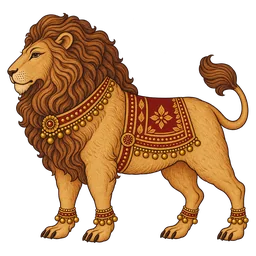
Leo Navamsa
Simha
The throne of the chart; ruled by the Sun (Surya)
The chapter in one minute
- Simha is the lion in the rashi.
- Nothing arrives untested.
- The cost never lands on the kingdom.
- It stops troubling a person the day two things are true — they are independent, and they work very hard.
The Navamsa at a glance
- Navamsa
- 5 · Leo
- Ruler
- Sun
- Element
- Fire · Fixed
- Rises from
- 3°20′–6°40′: Cancer, Scorpio, Pisces · 13°20′–16°40′: Aries, Leo, Sagittarius · 23°20′–26°40′: Taurus, Virgo, Capricorn
- Planets at home here
- Sun own sign
Leo · sign 5 · the 5th house of the Kalapurusha
Section A · Who Carries This Navamsa
One thing before anything else, because it governs how every reading in this chapter should be delivered.
The class opens on a bhajan. Patwaar ke bina hi meri naav chal rahi hai — my boat is moving without a rudder. Karta nahi main kuch bhi, sab kaam ho raha hai — I am doing nothing, and everything is getting done. Karte ho tum Kanhaiya, mera naam ho raha hai — you are the one doing it, and my name is what gets made.
And then the instruction: in Leo Navamsa we become too much of this — that I am the one doing it. Understand that you are not. Whatever yash and keerti you are receiving is arriving because of poorva punya. Stay a little humble.
Every reading in this chapter should be given with that sentence somewhere behind it, because this sign forgets it faster than any other.
You can also recognise it before the person has done anything visible. Put ten opinions in one room. Everyone speaks. Everyone explains. And then, without any formal vote, the room turns toward one person for the sentence that will actually stand.
That person may not be the loudest. They may not even have spoken yet. But the final decision has already travelled to them. This is Leo Navamsa: not merely the person who wants authority, but the point at which scattered authority becomes one command.
There is a person in every family who was never handed anything easily. Even what was rightfully theirs came wrapped in a test first.
Simha is the lion. In the rashi that is what you were given — courage, presence, a natural claim on the room. In the Navamsa it stops being the lion and becomes the throne the lion has to deserve before it is allowed to sit down.
Before we go into the texts, hold one rule. Leo Navamsa stops troubling a person the day two things are true — they are independent, and they work very hard. Everything difficult in this chapter traces back to one of those two being missing.
The Life That Teaches This Sign
There is no faster way to learn Leo Navamsa than to watch it run through one life from beginning to end. So we will walk through Rama’s — and stop at every turn to name exactly what is being shown.
- 1
The Child Who Was Asked For
Dasharatha had everything a king could want and no son to give it to.
- 2
Handed Over at Twelve
Then Vishwamitra walked into the court and asked for him.
- 3
The Bow Nobody Could Lift
Janaka’s hall was full of kings who had come to lift Shiva’s bow, and full of kings who had already failed.
- 4
The Morning the Crown Came Off
Manthara worked on Kaikeyi for days.
- 5
What He Became in the Forest
He could have spent fourteen years waiting.
- 6
The Deer That Was Not a Deer
Ravana did not defeat Rama.
- 7
Building an Army Out of Nothing
He had no forces, no treasury, no allies, and no standing.
The Child Who Was Asked For
Dasharatha had everything a king could want and no son to give it to.
So he performed a sacrifice. Not a ritual of convenience — a putrakameshti yagna, the whole apparatus of a kingdom turned toward a single request. And out of that fire came a bowl of payasam, and out of that payasam came four sons, and the eldest of them was Rama.
Think about what that means. Before the child drew breath, an entire kingdom had already spent itself asking for him.
That is purva punya arriving as a bill already settled. Nothing about that birth was earned by the boy. This is the first question in any Leo Navamsa chart — what account is this person actually drawing on, and does he know it exists.
Handed Over at Twelve
Then Vishwamitra walked into the court and asked for him.
Not for a blessing. For the boy himself, to walk into a forest and stand guard over a sacrifice that demons were tearing apart. Dasharatha, who had waited a lifetime for this child, nearly refused. Vashistha told him to let the boy go.
So Rama went. Twelve years old, walking out of a palace behind a sage, into a forest full of things that eat men.
Leo Navamsa does not let a person stay comfortable for long. The first real purpose arrives early, and it always involves standing guard over something that is not yours.
The Bow Nobody Could Lift
Janaka’s hall was full of kings who had come to lift Shiva’s bow, and full of kings who had already failed.
Rama walked up to it. He did not brace himself, did not make a performance of it. He lifted it, strung it, and the bow broke — and the sound of it going was heard, they say, across the whole of Mithila.
Every proud man in that hall felt something break with it.
This is the sign marking territory. Two people cannot hold one seat here. Notice he did not negotiate, did not compete politely, did not out-argue anyone. One act ended every rival claim in the room at the same instant.
The Morning the Crown Came Off
Manthara worked on Kaikeyi for days. Slowly, patiently, the way poison is administered.
And on the night before the coronation, Kaikeyi asked for her two boons. Bharata crowned. Rama into the forest for fourteen years.
Here is the part worth sitting with. Rama did not argue. He did not ask why, did not appeal, did not wait for morning to see whether his father would change his mind. He touched Dasharatha’s feet, and he left. The kingdom was his by every right anyone recognised, and he put it down without one word of protest.
And here is the ninth-house reading of this sign, stated plainly. What did Dasharatha actually give Rama? Fourteen years of exile and a saint’s clothes. Leo Navamsa in the ninth house does exactly this — the father makes a decision that costs the child everything, and the child absorbs it without protest.
What He Became in the Forest
He could have spent fourteen years waiting.
Instead he went looking for work. Rishis were being torn apart in those forests by things that came at night, men doing quiet practice with nothing to offer him and no way to pay him. Rama hunted them down, one settlement at a time, for years.
He was not building anything. He was not owed anything. He simply could not walk past it.
This is the sixth-house face of the sign. It fights consistently, for other people, in conditions nobody would choose, and it asks for nothing back.
The Deer That Was Not a Deer
Ravana did not defeat Rama. He never even faced him.
He sent a golden deer to draw Rama away from the hut. Then he waited until Lakshmana had gone too. Then he came to the door dressed as a mendicant — the one figure in that culture nobody refuses — and asked for alms, and took her.
Adharma arrives here wearing a friendly face. The serious attacks on a Leo Navamsa life almost never announce themselves. Watch for what walks in already trusted.
Building an Army Out of Nothing
He had no forces, no treasury, no allies, and no standing.
What he had was Sugriva, an exiled monkey king with his own brother’s boot on his neck. Rama backed him, and Sugriva backed Rama, and out of that one alliance came the army that eventually crossed an ocean on a bridge of stones.
Diplomacy and alliance-building are real strengths of this sign, and they show up hardest when the person has been stripped of everything else. Give this placement nothing, and watch what it assembles.
The Brother Who Changed Sides
Vibhishana was Ravana’s own blood.
He told his brother to return Sita. Ravana threw him out of the court. And Vibhishana walked across an active battlefield to the other side — not for a title, not for a bribe, but because of what he had seen in the man standing over there.
Character alone moves people in this sign. Not offers. Not pressure. Just the visible fact of how somebody conducts himself.
The Kingdom He Gave Away
Lanka was taken. Ravana was dead. The city was his by every rule of war.
Rama crowned Vibhishana king of it before he left, and went home with nothing.
The Sun is always a giver. In this sign a person wins the throne and hands it to somebody else — and does it repeatedly, often without noticing that they have.
Ram Rajya
Then Ayodhya, and the coronation, and the thing his name still means.
Srimad-Bhagavatam says the age itself behaved like Satya-yuga under him. No disease. No grief. No fear. No fatigue. Nobody cheated in the markets. Nobody afraid on the roads.
Thousands of years later his name is still the measure a ruler gets held against.
This is what the sign is actually reaching for. Not power, and not comfort. A name that outlives the kingdom and becomes the standard other people are judged by.
And Then a Washerman Spoke
One man. In a lane. Doubting Sita’s purity out loud, over nothing but gossip.
And Rama — who had faced Ravana, who had crossed an ocean for her, who had held every line without flinching — sent his own pregnant wife into the forest, to protect the name of the throne.
She had walked through fire in front of an army to prove what he already knew. It was not enough. Somebody talked, and the king chose the kingdom.
That is the last reading, and it is the one to carry out of this chapter. This sign’s damage almost never lands on the kingdom. It lands on whoever is standing closest to the throne.
The Nature of This Navamsa
Ten things. Rama’s life carries the first four.
It Marks Its Territory
A young lion does not inherit its ground. It fights every lion already standing on it, one at a time, before any of that ground is actually its.
Two people cannot run one territory here. Rama did not negotiate for Sita. He broke the bow, and every rival claim in that hall ended in the same moment.
Status and Fame
This sign wants recognition before almost anything else. Not quiet affection — public standing, from people whose opinion carries real weight.
Rama’s name outlived his kingdom by thousands of years and is still the yardstick. That is what this sign reaches for, whether or not the person can say it out loud.
Purva Punya — the Debt Already Paid
Whatever status or comfort shows up here was not earned in this lifetime. It is past merit arriving as a bill already settled.
Say it to a client plainly: it looks like you are doing it, but somebody else’s account is paying. A little humility here does more than any remedy in this chapter.
Nothing Is Given Free — Something Purifies You First
Before this Navamsa hands over anything, it sends someone to burn away what is not yet worthy of holding it. Never a stranger. Always the person closest to whatever that planet signifies.
Rama’s purifier was his own stepmother, and the crown came off the day before it was due to go on.
For the Sun, the father, or the state. For the Moon, the mother, or your own moods. For Mars, siblings and rivals. For Mercury, colleagues and open debate. For Jupiter, elders and teachers. For Venus, the spouse, who finds fault and will not stop until the pride breaks. For Saturn, seniors and the weight of the crowd. For Rahu, your own obsession with status, popped by public disillusionment. For Ketu, a sudden crisis inside a partnership.
To understand the next six points, we take one more king from the same solar line.
The King Who Would Not Bend One Sentence
Rama shows you the sign at its height. This one shows you what it costs.
A Sage Asks for a Gift
Harishchandra was known across the world for exactly one thing. He had never, in his life, said anything untrue.
Vishwamitra came to his court and asked him for a gift.
He gave the kingdom. Not a share of it — the throne, the treasury, the land, all of it, handed over in an afternoon without argument, because that is what a king of that line does when a brahmana asks.
That was not the test. That was the door opening.
The Fee for Having Given Everything
Because Vishwamitra accepted the gift, and then asked for the dakshina.
Sit with the shape of that. A gift is not complete until the fee that accompanies it has been paid. Harishchandra had just given away every possession he had on this earth, and by doing so had created a debt he now had no means whatsoever of settling.
He had to pay a fee for having given everything away.
Leo Navamsa does this. It will not let a person be generous cheaply. Whatever is given, something further is owed on top of it.
One Month
He asked for time. He was given a month.
He walked out of a kingdom that was no longer his, his queen Shaivya and his son Rohitashva behind him, and went to Kashi to earn what he owed.
He could not. The month closed anyway.
Sell Me
It was Shaivya who said it first.
She argued it as dharma — that keeping his word was the higher thing, and that she was the only asset the family had left.
He hesitated. Then he did it.
An old brahmana bought her as a housemaid and dragged her away by the hair. The boy ran after his mother crying, and she turned to the man who had just bought her and begged him to buy the child too, so they would not be separated. He agreed. For a little more.
And it was still not enough.
So Harishchandra sold the last thing in his possession, which was himself.
Watch the order — kingdom, wife, son, self. Every single thing closest to him made subordinate, one at a time, to the one thing he would not put down.
The Gate
He was bought by a chandala and set to work at the burning ground.
His job was to collect the fee before a family was allowed to light the fire.
A king whose name sits in the same dynastic lists as Rama’s own stood at that gate, taking coins from the grieving.
This is the sign stripped of everything it normally runs on. No throne, no name, no recognition — and the rule still standing.
The Night They Did Not Recognise Each Other
A year passed like that.
Then a snake bit Rohitashva while the boy was gathering flowers for the man who owned him, and he died.
Shaivya carried the body to the burning ground herself. At night. Alone. There was nobody else and no money for help.
And when she reached the gate, neither of them knew who the other was.
A year of that life had changed them past recognition. The king and the queen stood on either side of their own dead child in the dark, strangers. It broke only as they began building the pyre, and he understood who was standing in front of him, and she understood who was taking the body.
And Then He Asked Her for the Fee
Knowing. Standing over his own son. In front of his own wife.
She had nothing on this earth except the sari she was wearing. She offered to tear it in half and give him a piece.
That is the moment the sky opened.
What It Actually Was
Indra came. Dharma came. And Dharma told him the truth — the chandala who had owned him for a year, who had set him at that gate, had been Dharma himself the entire time.
The boy was returned. The kingdom was returned.
Now read that as an astrologer
Vishwamitra never attacked the throne. He asked for it, and it was handed over in an afternoon, and losing it did not touch that man at all.
What he attacked was the one sentence people said about Harishchandra. He found the single thing that man would not let go of, and then made that thing cost the kingdom, the wife, the son, and the man’s own freedom, one instalment at a time.
There is one astrological detail here worth writing down. Yama — death, judgment, the reckoning — is what tested this king hardest, and he did it through the death of a son. In the chart, that pressure comes from Capricorn Navamsa, which sits sixth from Leo, the house of struggle and debt. Wherever Capricorn touches this sign, expect exactly this kind of trial: something taken through no fault of the person’s own, purely to find out whether the one rule they live by survives it.
And now the reading nobody writes down, so write it down.
His truth was kept. Look at whose bodies kept it.
A client with this placement can dismiss almost any warning you give them. They cannot dismiss this one. Harishchandra was correct at every step, admired by everyone, tested by heaven itself and found perfect — and his wife was still sold, and his son still ended up on a pyre.
So when someone sitting in front of you says their standards are simply not negotiable, that they cannot compromise, that this is who they are — you have one sentence available.
So were his. Ask his wife.
Setting the Rules
Wherever this Navamsa operates, it writes the rules the room runs on and expects everyone else to follow without being consulted.
Harishchandra’s one rule was truth, and he never had to announce it. Everyone in that household already knew what would happen if it bent.
Center of Consciousness
The old texts call this the heart of the zodiac. Not one organ among many — the one that, if it stops, nothing else continues.
That single rule was exactly that kind of heart. His throne, his wife, his son, his own freedom all existed around it. Everything else became negotiable the moment it was tested. The rule never did.
Every Planet Becomes Subordinate
Whichever planet sits here, everything else in that chart gets treated the way a king treats their ministers. Useful. Managed. Never quite an equal.
You just watched it happen in order — kingdom, wife, son, freedom, each made subordinate to the one thing Harishchandra would not put down.
Thinking Style and Management
The mind here does not wonder whether it should be in charge. It manages the way breathing happens, without being decided on. Ten people or a hundred, an entire household running two separate lives inside it — this sign organises all of it and rarely notices the effort as effort.
Personal Values, Lineage, Public Status, World Fame
Four things travel together here and rarely arrive separately. What a person privately believes about themselves. What the family name is worth. What the public thinks. And at the largest scale, what the world remembers.
Rama had all four at the highest setting available and still lost his own household to the fourth one. Harishchandra held the same name — chakravartin, in the same dynastic lists — and watched it mean nothing at a cremation gate where nobody knew who he was.
Burn Completely to Shine
This comes straight from the Gita and it is the moral centre of this Navamsa. A lamp does not light a room by holding oil back for later. It burns completely, or it does not really shine.
Rama burned his own household to keep a kingdom’s trust intact. Harishchandra burned everything he owned, and then himself, to keep one sentence true.
That is this sign in its final form. It is built to burn at full output — and the version of it that means something is the one that chooses, on purpose, exactly what the burning is for.
The Risk Nobody Warns This Sign About
One thing belongs here before the planets, because it shadows every good reading in this chapter.
Leo gives badnami. Defamation. The same visibility that brings the recognition is what carries the damage when it comes, and it travels further and faster than it would for anybody else.
A quiet person’s mistake stays in the room it happened in. This sign’s mistake does not. And because this placement genuinely does behave well most of the time, the accusation lands harder — people are more scandalised by it, not less.
So the instruction is not to hide. It is to understand that here your conduct is the only defence you will ever have, and that it has to be built long before it is needed. A reputation in this sign is not what people say about you. It is what they cannot say.
What Must Be Known Before Placing the Planets
Five rules belong here because they change how the entire planet section is read.
First, this Navamsa has a deep connection with college and higher education. A relationship, rivalry, identity or promise formed during those years can continue running the life long after the degree has ended. When Leo is strong, never dismiss the college period as background. It may be where the throne was first rehearsed.
Second, the Sun signifies health and radiance. With a strong Leo Navamsa, health is not a side topic. Face, vitality, glow and the ability to keep appearing are part of the person’s wealth. A throne is useless if the body cannot continue sitting on it.
Third, hard work here does not mean endless labour for its own sake. It means accepting responsibility in the right place, taking the decision, and converting inherited merit into action worthy of the inheritance.
Fourth, light planets perform badly here. A throne needs weight. Before making a large prediction, ask whether the planet is strong enough to hold the chair, whether the source sign supports it, and whether Jupiter or Ketu can restrain the Sun when restraint becomes necessary.
Fifth, formality is one of the marriage’s real enemies. Publicly honouring a partner while privately reducing the same person to the machinery of the household creates the distance that breaks the relationship. And when two powerful Leo patterns live under one roof, divide the territory early. Decide who governs what before every small choice becomes a referendum on the throne.
Regular agnihotra or havan returns throughout the teaching for a reason. Fire is not being used here to make Leo larger. It is being used to remind the person that the fire was never theirs to own.
Lagnamsha Dasha — When Position Comes and When It Is Tested
The classroom rule is short: Leo Navamsa gives position. Sagittarius Navamsa tests it.
When Leo and Sagittarius activate one another inside a Lagnamsha dasha, watch the office, company, reputation and burden of responsibility together. This does not automatically mean a fall. It means examination. Whatever in the position was never durable becomes visible.
That is why conduct matters more than display in such a period. The higher the throne, the more public the inspection.
It marks its territory
It wants status and fame, publicly, from people whose opinion carries weight
Purva punya
Nothing is given free
It sets the rules and expects them followed without consultation
Leo Navamsa
Sun
It is the centre of consciousness
Every other planet becomes subordinate
It manages natively, without noticing the effort
Personal values, lineage, public status and world fame travel together
Burn completely to shine — and choose, on purpose, what the burning is for
Section B · Planets in Leo Navamsa
Leo Navamsa
Ruled by Sun

Sun
Own sign
Two suns in one chart. Public queen, private staff.

Moon
Royalty by instinct. Cannot ask, cannot receive.

Mars
The right hand of power. Called for every crisis, checked on after none.

Mercury
Close to powerful people, rarely powerful in its own name.

Jupiter
Wins the kingdom for somebody else, then guards their door for life.

Venus
Marries an ego, never admits a fault, and gives polygamy or a sautan.

Saturn
Fights for everyone without power, claims no position for itself. Also gives sautan.

Rahu
Takes the chair rather than waiting for it. Blamed for what it did not do.

Ketu
Undermines every throne nearby, including its own peace. Settles only when given a real position.
Every planet here inherits the same starting condition — territory, status, an assumption of respect. The whole reading is what it does with an inheritance it never had to earn.
Each planet runs the same way, so you can work fast with a chart open.
How to Use the Sharp Predictions
One reading rule governs the sharp predictions that follow. When this chapter says that Venus gives polygamy, Saturn gives a sautan, Mars-Rahu gives violence, or Rahu can open a conversion pattern, it is naming an outcome repeatedly found in the studied charts.
Read those sentences at full strength when the planet is capable of delivering them and the source sign, house, aspects and operating dasha repeat the same story. The supporting conditions do not weaken the prediction. They tell you when you have earned the right to say it.
The Sun
Surya Narayan has not taken a single day off since creation began.
Not one. No festival, no illness, no grief of its own has ever bought the Sun a morning in bed. It rises, it crosses, it sets, and it does it again tomorrow — and the entire world is arranged on the assumption that it will.
That is not power. That is being welded to a chair.
Look at what happened to every king of his line. Harishchandra could not put down one sentence about himself and lost a wife and a son to keeping it. Dasharatha could not put down a promise and died of it. And Rama could not put down the position of ideal king — not for exile, not for war, and not even for his own pregnant wife, whom he sent into a forest rather than let the throne be spoken about. They called him Maryada Purushottam. The word maryada means limit. The greatest man within the boundary — and the boundary is the point.
Jupiter here wins a kingdom and binds itself to the person it won it for. The Sun binds itself to the position itself, and cannot get free of it even when the position is destroying everything standing near it.
Two suns in one chart, and neither one of them is allowed to rest.
- Total management. Ten people or a whole household run through this person, and the effort never registers as effort.
- The ego is structurally large, like a thumb bent backwards. The further a thumb bends, the more compromise a person can make. This Sun will not bend the thumb.
- Standards work like a fixed deposit. Time was set, time holds. Nothing negotiable once stated.
- Never needs an introduction from anyone. They introduce themselves and make their own entry into every room.
- Wants their own home. Cannot function long inside someone else’s house or someone else’s rules.
- Everyone who enters that house — driver, cook, help — is treated, privately, as their own staff.
- Fights for position before they fight for love.
- Controlled only by Jupiter or a strong Ketu. A guru, a sannyasi, someone whose authority is not worldly. No ordinary person moves this Sun.
- Marriage reads more like an arrangement between two thrones than a romance. The less each side insults the other publicly, the better it holds.
- In public they make their partner a queen. In private the same person can be treated like staff and expected to be grateful. That gap, unclosed, is what actually ends these marriages.
- Diplomatic in the second house. Kul, maryada, parampara are weighed before they speak. Insult their family publicly and the marriage does not recover.
- Sexual availability follows their mood, not the partner’s.
Dev Dosha — name it on sight. Sun and Moon together here, especially in the ninth, is an amavasya built into the D9. The Moon cannot shine that close to the Sun. The result is a life lived partly in secret from the very authorities this sign answers to — father, guru, government. Controversyprone: rebels against real injustice and then gets caught for having done it quietly instead of openly. The remedy is the one this sign keeps returning to. Stop hiding.
Case notes.
- Sun in the 6th with Rahu. Confirmed directly — the ego runs so extreme that if someone calls him over, he will not go, and he cuts people off entirely rather than bend. Divorce risk flagged high.
- Sun, Venus and Mercury together in the 9th, the pure Suryavanshi combination. He would never be drawn to a woman who kept other men in her life. He spoke with roughly a hundred women before choosing one, and that marriage was everything to him.
- A widower with Sun, Venus and Saturn on the lagna. His late wife had feared him enough to hide things rather than speak plainly. Only after her passing did he understand what “eyes dazzling” had meant about his own presence in the house.
- A man with the Sun in the 5th who works with government tenders. The attraction to institutional office, visible authority and the red beacon was immediate. The Sun does not merely want employment. It wants recognised office.
Ask them one thing. When you write “I love you” on paper, does it come out formal — like a notice rather than a feeling? If they laugh before answering, you have it.
The trap. They hold everyone, including themselves, to a standard so consistent that nobody ever gets to be simply loved. Only judged fairly.
Remedy. Surya Narayan directly, the Gayatri Mantra, and regular agnihotra.
The Moon
Royalty by instinct rather than by title.
Krishna held no throne of His own for most of the Mahabharata and ruled anyway. Pandavas, Kauravas, the whole assembly turned toward Him before any decision was made, because He had already won the only throne that mattered — the one inside every heart in the hall.
It cannot eat in a small place. Cheap food, a cramped restaurant, a plain suitcase, none of it will do. Everything upgrades automatically.
- Extremely particular about where and with whom it eats. Insult it once over food or company and it becomes permanently selective. It will feed you gladly and never eat on your money again.
- Almost cannot ask for anything, including money. Asking feels close to death.
- Cannot accept a gift without immediately giving something back.
- Naturally generous with staff and service workers. Tips well, pays a housemaid’s children’s school fees, remembers who cooked the meal.
- Runs on feeling, not schedule — and that creates friction, because Leo Navamsa itself wants everything on schedule. With Saturn prominent the person follows the rules anyway. Without it, timing around food and household routine becomes a permanent flashpoint after marriage.
- A near-telepathic bond is possible, especially with the Moon on the Navamsa lagna, sometimes to the point where only two people can really live in that house.
- Marrying someone financially struggling is a genuine strain. The instinct is upgrade and hospitality, provided the guests are its own to host.
- The marriage runs on ordinary things. Food made on time, given on time, clothes washed on time. Perfect these and it holds.
- Sacrifice is common, usually the woman’s own career. She gives up her job after children and absorbs the household — and that sacrifice, not the grandeur, is very often what actually holds the marriage together.
- In Leo Navamsa the Moon distributes food. Feeding people regularly, buying food for others, serving at scale.
Case note. A woman confirmed nearly every point — an inter-caste marriage her parents resisted, now fifteen years settled, real warmth with her in-laws, and her working career given up entirely once children arrived. Exactly the trade the placement asks for.
Ask her one thing. Have you ever gone quiet about wanting something — food, money, attention — because asking felt beneath you? A long pause usually confirms it.
The trap. Gives constantly and cannot receive, so the people who love it most never get to take care of it back.
Remedy. Bhagavan Sri Krishna and Mata Lakshmi. And practise receiving deliberately.
Mars
The right hand of whoever holds real power. Two deities carry it.
Narasimha tore Hiranyakashipu apart and did not take the throne — He put Prahlada, the rightful and devoted prince, back on solid ground. Hanuman did the same at the far end of the Ramayana: after Lanka fell, He stood beside Rama while Vibhishana was crowned in Ravana’s place.
Neither wanted the seat. Both decided who sat in it.
- Handles everything as an emergency and does it well. Managerial crises, family disputes, any situation needing someone to physically show up. Powerfully attractive, especially to people drawn to someone who visibly handles a crisis. Gets noticed in gyms and fitness spaces, because this sign sharpens how a person carries themselves.
- Fearless in front of numbers. A hundred people in a room does not intimidate this placement.
- Gets picked repeatedly by seniors, almost without trying. Even after real mistakes, the same person keeps getting pulled back onto the team.
- Physically hot. Fast digestion, strong appetite. Heartburn, acidity and skin heat are common. Handles harsh work without flinching — medical equipment, X-rays included.
- A specific talent for rhythm and percussion, the mridangam in particular. At temple festivals this Mars rises into the organising role and runs the whole event unasked.
- When it runs badly the damage is silent. Punishment behind closed doors, with no outward sign anyone could point to.
Case note. A woman’s Mars ran from Scorpio in the 10th of the D1 into the 10th of the Navamsa in Leo, with the Navamsa lagna in Scorpio. Every boyfriend she had ever had, she confirmed, ended up beaten by her. Onesided, every time.
Ask them one thing. When something goes wrong in a group, are you usually the one who takes charge without being asked?
And the strength, which this placement rarely hears. Mars here is the ruler who fights the battle personally rather than sending somebody. It defends people who cannot defend themselves and it does not need to be asked twice. Where a family or an institution is under real attack, this is the placement that stands in front of it — and everybody else finds out afterwards who did.
And the reading that explains most of the behaviour people complain about: Leo Navamsa also represents the dating period, and Mars is extremely good in it. The chasing, the roaming, the pursuit — that is not a character flaw being reported, it is this placement running normally.
A strong planet like Mars in Leo Navamsa is genuinely excellent for a leadership position, provided Jupiter and Ketu have matured. And the class gives a live portrait of it. A teacher who would find ten mistakes in anything you made and send it straight back. People fled from them. And they were completely immovable when it came to protecting their own students. A great many of the people they trained now run centres themselves. They empowered them.
So tell the client the whole thing. You will enjoy working under this placement, because it is with you when the problems actually arrive and it knows how to handle them. And if this is your own chart, always target the high position — you will get it. Look for the Sun, not for Jupiter.
Mars with Rahu here is the exception and it must be said plainly. It will hit, a hundred and ten percent, and very badly, and accidents follow. Where the placement is being used to exploit people, Saturn arrives later and explains it properly.
Observed in the studied charts. One Mars-Rahu case ran an enterprise by bringing in young labourers because they were cheap, stretching their hours and delaying their wages. The same person used school students as unpaid labour and abandoned them after the work was done. That is the exploitative form of the combination. The violence is not only a fist. It is power treating another body as disposable.
The trap. Always the one called for the crisis, rarely the one anyone checks on afterward.
Remedy. Bhagavan Hanuman and Narasimha. Physical service rendered without asking anything back. Help first; do not interrogate whether the person will ever be useful to you.
Mercury
Mercury here gets pulled into rooms full of very powerful people.
It is the one planet in this chapter that can genuinely convert that closeness into standing of its own, because it wins the way Buddha won. He never raised an army and never claimed a throne. He sat across from kings like Bimbisara and Prasenajit and out-argued them, one exchange at a time, until men who commanded armies were bowing to a teaching.
That is the gift, and also the risk. Winning the room and owning the room are two different things.
- Treats marriage lightly at first. A game, decided quickly, until the weight of it catches up.
- Ends up extremely close to powerful people, but risks becoming their errand-runner rather than their equal.
- Real risk of becoming servant to a wealthy relative — running the rich uncle’s business, never building an independent name.
- Excellent speechwriter, court reporter, transcriber, spokesperson. The words are sharp. The credit goes elsewhere.
- A specific risk of becoming the go-between in corrupt dealings. With Rahu involved this sharpens considerably.
- Fame and marital stability move in opposite directions. More public recognition, more strain at home.
- Romance arrives through teaching — a classroom, a coaching session, a fifth-house setting where instruction turns into attraction.
- Career instability from office politics. Good work draws attention that turns into rivalry with a senior.
Case note. A man confirmed career instability tied directly to this placement — job changes driven by office politics, his own strong performance creating friction with seniors who felt threatened.
One case shows the gift in full. A woman moved through radio, profitable stock trading, psychiatry, child counselling, painting, hip-hop and Bharatanatyam. Every interruption became another skill, and nearly everyone who worked with her became wealthier. That is the brahmin combination. The problem was never learning. It was allowing the learning to become a throne in her own name.
Ask them one thing. Do you ever feel like you are the reason someone else is getting rich, while your own name stays in the background?
And here is the central problem with this Mercury, which the class states more sharply than anything else in the planet section. This person stands with very high-class people, moves among them constantly — and cannot build their own authority.
You will feel permanently overpowered. Always doing somebody else’s work. Always making somebody else rich. Everyone will sponsor you and fund you, and you will become somebody’s trusted right hand.
So the instruction is blunt. Be your own sugar daddy. Make yourself rich, not others. You must not be the right hand — you have to be the main character.
And the mechanism for getting there is not effort. It is isolation. This placement needs time away from the powerful people it orbits, because that is the only condition under which it builds an identity of its own.
One more law that governs the whole sign, given here: light planets deliver very badly in Leo Navamsa. You need heavy planets. To rule, you need strong ones.
Two more readings to check. This Mercury chooses the wrong partner almost every time — marriage is treated like a game of dolls and the decision gets taken exactly that way. And the more fame it collects, the more the married life deteriorates. Those two move together here.
Its gift, though, is real: it makes a brahmin combination, and this person can learn an extraordinary number of skills. Remedy — start with copper and shift to manikya, and take a formal certification, because the Sun arrives through the certificate.
Do not treat that certificate as decoration. In the studied charts, Mercury had already done the work and already stood among important people. The credential was what allowed the authority to become visible as its own rather than remain borrowed from the room.
The trap. Becomes indispensable to someone else’s throne and never builds one of its own.
Remedy. Mother Tulsi. And deliberate time alone, away from powerful circles, to build a name that does not depend on anyone else’s. Be your own patron. Make yourself rich, not others.
Jupiter
Vamana did not fight Bali for Indra’s stolen kingdom. He used intelligence and he used scripture — three paces of land, asked for correctly, in a form nobody could refuse. Bali’s own guru Shukracharya saw the trap and warned him. Bali gave anyway, because the request had been made properly.
Then watch what happened afterward. Vamana won three worlds and did not walk away with them. He bound himself to Bali, stood at his door in Sutala, and stayed there as his gatekeeper.
That is this placement exactly. It uses knowledge to win territory — and then it cannot leave the person it won it for.
Look at where Jupiter always sits. Brihaspati is guru of the devas, permanently attached to Indra’s court, unable to leave him. Vashistha is bound to the Suryavamsa across generations — Rama’s line, not his own. Shukracharya took the same role with Bali and spent the rest of his story entangled in that king’s affairs.
The exact office is rajapurohita. The royal priest does not merely bless the king. The priest carries the moral and intellectual weight of the kingdom, and then suffers because the king’s decisions become inseparable from that role.
- Wins position and territory for somebody else, using knowledge rather than force. Rarely for themselves.
- Once attached to an institution, a family or a powerful person, they genuinely cannot leave. Not weakness — the nature of the role.
- Guides big people, and those bigger people become dependent on them. Seniors walk to them rather than the reverse.
- Spiritual and traditional-knowledge material gathers in the home naturally, with very little effort.
- Will not listen to correction. They need somebody equally large before they will accept a word, which is why they all become philosophers.
- Trust is the wound. Jupiter’s light is lost in the seventh house here. It places faith in the wrong person repeatedly and absorbs debts that were never its own.
- Everyone around calls them a saint and sees only good — and there is nothing underneath the appearance to actually hold.
- With Ketu alongside, a genuine raja yoga. But it cannot afford to wrong anyone, because the same strength that lifts it turns back just as fast.
- It can give several children, and recognition through those children, because Leo remains the natural 5th-house field even when it appears elsewhere in the Navamsa.
Case notes.
- A woman with Ketu and Jupiter in the 1st house of her Navamsa, Leo also rising in her D1. She confirmed the raja yoga precisely — genuinely unable to wrong anyone even when it would have been easy. Six months after a major life event she went through real upheaval including legal trouble, and the combination held her through it.
- A husband with Jupiter from Aries into the 11th house. Enormous difficulty first, money afterward. Deep knowledge, no money for years. No money even to study as a child. Now, in his own words, he could run ten households. And his seniors walk to him and become dependent on him — confirmed exactly as taught.
- A Jupiter-Ketu woman exposed seniors who were selling private company data and had to leave the job herself. The organisations that removed her later declined or closed. Jupiter gave the ethical office. Ketu made her investigate the throne rather than submit to it.
Ask them one thing. Do people come to you for guidance more than you go looking for it? A yes, offered a little uncomfortably, is the clearest confirmation.
What Jupiter does well here is confer legitimacy. This placement makes the person whose blessing actually counts — whose word settles a dispute, whose presence makes an occasion proper. That is not decoration. In a family or an institution, somebody has to carry that, and here it is earned rather than claimed.
And the specific difficulty when Jupiter sits here with Ketu, because the two fight each other inside the same person. One week it is: I must do everything for everybody, all of it is social service. The next week it is: I want none of it, let me take sannyas. Neither settles, because Jupiter wants to give and Ketu wants nothing.
The career consequence is exact. This person does not want to work under anybody. They find the mistakes, they cannot tolerate being dominated, and they turn into the nani of the workplace.
And the remedy the class gives for it is unlike any other in this book: maun vrat. A vow of silence.
The reasoning is precise. The problem here is not the work and it is not the ability. The problem is the speaking. Ketu makes it aar ya paar — one line comes out and a fight has started. So take a day and say plainly: today is my maun vrat, I will answer only on message, I will not speak. The class points at the hill sadhus who only ever wrote and never spoke, and says the position comes from exactly that.
One more conflict to check for. If Mercury rules the income houses while Jupiter and Ketu sit in Leo Navamsa, the two cannot both run. They are at odds. And be honest about what Mercury’s work actually involves — insurance selling, product sales, the ticket counter, the bank cashier. However fast that cashier works, they still get abused all day. Mercury’s job is to listen to abuse, and this Jupiter cannot do it.
The trap. They give an entire kingdom to somebody else, then stand at that person’s door for the rest of their life and calls it duty.
Remedy. Bhajans, kirtan, traditional scripture kept physically in the home. Feed cows. Hold the ethical line hardest during any Ketu period.
Venus
Venus here marries into ego, and two figures show both sides.
Shukracharya trained Bali so completely that his student took Indra’s throne for a season. Venus here can make someone powerful enough to win without first asking whether the win is deserved. And Shukracharya is himself a bound guru, tied to the asuras exactly as Brihaspati is tied to Indra — the same binding Jupiter carries, from the other side.
Parashurama is the correction to that impulse. A warrior given an axe to cut kshatriya pride down to size, twenty-one times over, whenever it forgot its limits.
- The spouse is genuinely egoistic in most cases. A fact to plan around rather than fight.
- Holds accounts, resources and connections in several places at once. Not dishonesty — a habit of never keeping all the reserves in one basket. With Saturn alongside this sharpens.
- With Rahu, hidden relationships. The spouse’s attachments run deeper than what is visible.
- Never accepts its own mistake. The single most defining trait. Unlike Jupiter, which can eventually admit fault, Venus in Taurus, Libra or Leo simply does not concede. Parashurama never repented for clearing the earth of kshatriyas. He was disciplined for it. He was never sorry. Only Lakshmana brought him to a stop.
- Do not address your partner in front of friends the way you would in private. The register has to change with the audience.
- Interior design and taste run strong. The home ends up resembling a private assembly hall. Music matters, specifically the shehnai.
- Check for multiple marriages in the family line.
Now the hard one, stated plainly because the class states it plainly. Venus in Leo Navamsa gives polygamy. It produces the person who keeps a second woman, and it produces the sautan in a marriage. Saturn in this sign does the same.
This is not “relationship complexity.” The collected cases describe a specific arrangement: not always a brief affair, but two women being maintained with the attitude that both occupy a wife’s place. Treat it as a study-based prediction. Confirm the strength of Venus or Saturn, the house, the source sign and the operating period — and when they repeat the story, say the story plainly.
Case notes.
- A woman with Saturn Vargottama, Leo to Leo. Everything arrived early — early marriage, early children, before she had the maturity to handle any of it. When the Saturn mahadasha began, the real difficulty started. Her husband, with Venus in Leo, took up with a woman at his own factory and kept her there permanently. His work collapsed to zero. Emotional and financial damage arrived together, the children had to struggle before their time, and years later the woman is still there.
- A woman with Venus, Saturn and Moon together in the 8th. Regular fights over food. A PhD holder, UPSC qualified, high-profile, and — the class named it directly — narcissistic, because Venus and Moon combining makes exactly that. Her love marriage failed. Her husband was the playboy, with no fixed person. Saturn with Venus meant her husband felt permanent pressure from her. He died after the divorce.
- A man’s Venus from Aries into the 2nd house. He dated people who arrived raw and unpolished and watched them grow, gain money and position under his influence. Never anyone already finished. He confirmed it directly.
- A Canadian family carried three marriages through the father — one ending in divorce, one in death, one continuing. Mars and Venus were both in Leo Navamsa.
- Venus with Ketu in Leo in the 9th appeared with deep involvement in dance and multiple partners from a young age. This is the pleasureand-detachment form: the experience is entered fully, but no single attachment is allowed to become final.
Ask her one thing. Do you speak to your partner differently depending on who else is in the room? A knowing yes, usually with a small laugh.
The strength here is genuine taste. This Venus knows what befits an occasion and what does not, and other people quietly follow its judgement on it. It also gives real generosity — this placement gives publicly, gives well, and gives to people who cannot return it. The display everybody notices is only the surface of something that is actually open-handed.
The trap. Manages an ego so carefully in public that the private relationship becomes a performance for an audience that never arrives. And because this Venus cannot admit fault, arguments here do not end with anyone backing down.
Remedy. Bhagavan Parashurama’s discipline, and radical honesty about where resources and attachments actually sit.
Saturn
Saturn here fights for everyone except itself.
Kurma held an entire mountain on His own back for a thousand years so the devas could churn the ocean for amrita. When the nectar came up it went to their hands, not His.
The class names this Saturn plainly. This Saturn is a communist. It fights for the labouring class, for people who cannot afford things, for anyone without power.
And that is the strength, so say it before the difficulty. This is the placement that keeps working after the recognition stops. It carries an institution through the years when nobody is watching and no applause is coming. The Sun in this sign needs to be seen. Saturn here does not — and that is precisely why the thing survives.
- Structurally on the side of the underprivileged. In the 5th house specifically, repeated advocacy for the elderly and for people who cannot afford basics.
- Loyal to the Chandravamsha over the Suryavamsha. Drawn to service and humility rather than status and command.
- Carries real fear of standing out. Push this Saturn onto the shining assembly this sign represents and it feels the way a person in house slippers feels being pushed onto a stage to receive a national award.
- The back-bench sitter by nature. And it studies harder before an exam than almost any other placement in the chart.
- Tests its own teachers constantly. It will hand a teacher a deliberately unsolvable question just to see whether the teacher admits not knowing. Does not want new rules imposed and quietly enjoys breaking existing ones. Works its own hours, works at night.
- Opposes authority only where it fails the poor. Never opposition for its own sake.
- Once it reaches a position it will not give it up easily.
- Very traditional in love. Drawn to quiet, devoted, old-fashioned partnership.
- The best teacher this sign produces. Patient, thorough, builds a student from the base upward.
- Real anxiety around intimacy is common, especially in the 7th house. With a supportive partner it improves steadily. Patience is the actual remedy.
- Old age is better than youth here.
- And, as with Venus, this Saturn gives sautan. Watch for it.
That last sentence is deliberate. The studied form is not merely jealousy. It is a second relational claimant becoming established strongly enough to function like another household. Do not announce it from Saturn alone, but do not erase it when Saturn, the relevant house and the running period all confirm it.
Case note. A cousin opened a small food-processing factory despite being warned to wait. During his Saturn dasha, 6th house, a worker’s hand went into the hot oil used for bhujiya, the factory was found unlicensed, and it was sealed by police the same week.
Ask them one thing. When you see someone in power, is your first instinct to check whether they earned it?
The trap. Fights so consistently for everyone without power that it forgets to claim any position for itself.
Remedy. Lord Kurma. Direct, unglamorous service to people without means. One practical distinction: feed the genuinely poor, not the beggars at a temple gate — that energy belongs to Rahu, and the charity works better aimed correctly.
Rahu
Rahu wants the chair, and wants it without waiting for it to be offered.
Varaha did not ask the ocean’s permission. The earth had sunk to the bottom of the cosmic waters and He went in after it on His own tusks, and re-established the world where it belonged. Nothing was handed to Him first.
The line for this placement is exact. Nothing here is given. It only arrives once it has been taken.
- Check directly: has this person taken something — money, credit, position — that was not freely offered? It happens more often than they will admit, even something as small as money from a father’s pocket as a child.
- Runs on saam, daam, dand, bhed. Whichever gets the chair fastest.
- Cannot tolerate simplicity or humility from someone claiming authority. A modest person in power reads as weak, and this Rahu pushes until that person either asserts themselves or loses the position.
- Creates illusion around wealth. Looks far richer than the numbers support, and that gap is where the real financial risk sits.
- In the 7th, 8th or 11th, expect genuine grey area. Roughly a quarter illegitimate to three quarters legitimate. Name it clearly.
- Cannot defeat legitimate, sattvic authority through force. It has to wear the target down quietly instead.
- Frequently drawn abroad for wealth, the Gulf in particular.
- Whatever house this Rahu sits seventh from gets starved.
- Blamed for things it did not do. School life spent being accused by other students while teachers refuse to believe them. Even where they did not cheat, everyone assumes they did.
- Never gets along with teachers — except Rahu-type teachers, the ones who break rules, do not follow the syllabus and are not afraid of anybody.
- Where it enters the 9th house, treated permanently as an outsider, and denied the rightful share. Rahu has to snatch. The 30 percent that should have come never arrives.
Now a serious one. When Rahu becomes very prominent here and has pushed the Sun out of a person’s life, conversion becomes a live risk. To read it: check the Sagittarius sign, then the 9th house, then where the 9th lord has gone in the Navamsa, then its dispositor. In one chart the 9th lord went to Capricorn Navamsa, its dispositor Saturn into Leo Navamsa, and Rahu into Pisces Navamsa in the 5th — the natural house of the Sun. That person converted. In another, the same pressure existed and did not land, because Jupiter and Moon sat strong in Pisces, Ketu in Aquarius kept breaking the illusion, and the person visited temples and chanted Vishnu Sahasranama daily.
Case note. A woman’s Rahu ran from the 2nd house of the D1 into the 9th of the Navamsa. Treated as an outsider everywhere, in family and career both. Her father died before her marriage. She received gold from him and nothing else. Politics in her career throughout. She has worked from Dubai for ten years, and built everything herself.
Ask them one thing. Have you ever taken something — money, credit, a position — that was not offered to you freely? The pause tells you more than the answer.
The trap. Gets the chair by taking it, and never quite trusts what it took.
Remedy. Lord Varaha. Strict honesty about how the position was actually obtained.
Ketu
Ketu here does not want to rule.
Matsya never once had to fight. He did not battle the flood that ended the last world — He towed the one boat that mattered through it, carried the seeds of everything worth keeping, and let a new creation begin without a single blow struck.
The class names this precisely. Like a chief minister who still sits on a protest outside their own office. There is always an itch saying the person currently on the throne should not be there.
- Genuinely precise. Does not make careless mistakes. Everything is deliberate, including the dissatisfaction.
- The best possible placement for starting a riot or a rebellion, because it has already detached from the outcome.
- Cannot rule and does not particularly want to, but cannot let whoever is ruling feel comfortable.
- Deeply uncomfortable being bound to any position. Leo Navamsa ties a person to a throne. Ketu resents being tied to anything.
- Check the father relationship directly. This placement rules best with the blessing of the pitris and struggles badly without it.
- Officially the manager, officially in charge — and sitting at home while somebody else runs the operation. The signature gets applied. The work happens elsewhere.
- No attachment to any position once reached.
- Genuinely good at finding fault — which is exactly why the Sun, wherever it sits alongside this Ketu, never feels at ease.
- Career gifts: photography, and a pull toward sacred images, temple deities, holy places.
- Ketu and Leo prominent together shrinks the social circle to nearly zero.
- Extremely picky about a partner, to the point of describing someone who does not exist — and then admitting that such people are not found any more.
- Instability is the deepest weakness. It finds so many defects that action is postponed until the throne is lost by inspection.
- Minimalism is a genuine behavioural signature. A new object enters only when an old one leaves. Open space in the hall or kitchen becomes psychologically necessary.
- Makes an excellent spy, because it wants nothing and so cannot be bought or threatened.
The verse the class ties to this placement: to remain equal toward all beings, seeking nothing, is the highest devotion.
Case notes.
- Twin brothers born four minutes apart, one married, one not. The unmarried one is treated with deference by their father and consulted first on every family decision. The married one, nearly identical otherwise, is barely consulted, and his own wife receives more respect than he does. The difference traced to the Sun sitting with Ketu in the 1st house of the married brother’s Navamsa.
- A woman with Ketu in Leo Navamsa in the 8th, whose mother is a teacher. The placement should have troubled her badly. It did not, because Ketu here needs position and she has one — regularly leaving the house, travelling, transferring, teaching five to eight hours a day. Leo Navamsa also represents the natural fifth house, so every day she teaches, she burns the pending karma directly.
- In one 5th-house case, Ketu appeared with fallopian-tube obstruction and a pilgrimage to a hill temple before conception. Keep the category correct. This is a pattern found in a studied chart.
Ask them one thing. When you finally reach something you worked toward, does the satisfaction fade almost immediately?
And two readings from the class that identify this Ketu immediately in a consultation.
It is extremely picky, and it does not know what it actually wants. Ask what they are looking for in a partner and the description they give you does not exist — and they will often say so themselves in the same breath: girls like that are not around any more.
And it gives serious ego and trauma, because Ketu here fault-finds relentlessly. That is not a personality flaw being reported to you. It is the placement.
The trap. Undermines every throne it comes near, including, eventually, its own peace.
Remedy. The Matsya avatara, and the verse practised rather than merely known.
The Combination I Will Not Soften
There is one combination in this sign I have to give you differently from the others, because I am not reading it from a case file. I am reading it from my own chart.
Jupiter on the lagna with Venus in the eighth house. Do not trust the person.
I include myself in that.
I am very different in my personal life and very different in the temple. That is precisely why I do not take personal consultations.
Let me give you the mechanics rather than the confession, because the mechanics are what you will actually use.
Venus in the eighth carries karma forward from a previous life, and it does not announce itself. In every chart I have examined with Venus in Scorpio in the eighth, extra-marital involvement was present. Not most. Every one.
And here is the part that makes it dangerous rather than merely difficult. This combination gives a genuinely charismatic personality — people are drawn to it, and it opens doors that stay shut for other people. The same placement delivers the lust in a hidden, motivated form. It does not arrive as an appetite you can see and refuse. It arrives dressed as something else.
So the discipline has to be structural rather than moral, because moral resolve is exactly what this combination is good at dissolving.
- When a Mars dasha, antardasha or pratyantardasha involving Venus is running, stay alert deliberately. Do not assume you are past it.
- I go to the temple in the evening rather than staying at home, because at home is precisely where this Venus activates.
- I do not allow anybody into my flat. That is not suspicion of other people. It is an accurate assessment of a placement.
- My own counsellor’s standing instruction to me has never changed, and I follow it.
And the warning I want stated most plainly of all, because it is the one that ends careers in this line of work. Where a Ketu dasha finishes and a Venus dasha begins, and that Venus sits in the eighth house, it is not good for a sannyasi. He will fall from the position — a hundred percent. Not because he is weak. Because the karma was already carried in, and the dasha simply opened the door on schedule.
I am telling you this about my own chart for one reason. An astrologer who reads a hard combination in somebody else’s chart and pretends they are standing outside it is not being honest with that person, and they will eventually not be honest with themselves either. Read your own chart first. Build the structure before the dasha arrives, not during it.
Section C · Where This Navamsa Rises From
One structural rule before the list, and it is not optional. Leo Navamsa never arrives from Gemini, Libra or Aquarius. Those three run the Libra-to-Gemini span and Leo does not fall inside it. If somebody has written you a Libra-to-Leo reading, that placement does not exist. Check the arithmetic before you check the person.
Nine signs can reach here.
The Earth Group — Taurus, Virgo, Capricorn
All three deliver the same thing in different currencies: money, and the position that money buys. Whatever is finance-related, loanrelated, industry-related, or involves solving a problem for a fee — you will get a position in it, and you will be genuinely rich.
From Taurus. You will get money in this life. That much is certain — whether it arrives as an FD, or through somebody’s death, it arrives. This is also the royal family combination, and if you were not born into one you will build one.
But three warnings ride with it. Do not become corrupt when the money comes, because Taurus into Leo brings enormous ego with it. Be careful how much wealth you display — Taurus is the resource and Leo Navamsa is the showing of it, so what gets displayed is money, family, connections and business, and that display attracts exactly the wrong attention.
And the hardest one, which nobody wants to hear. This combination gives the money, and the family fights. As the family breaks and the relationships break, you grow. Position rises as people disappear. One person is eliminated and the money increases. And as the family grows back, the position falls. Watch it happen once and you will never read this source casually again.
A small confirming detail: in a house with this source, whoever feeds the people and whoever holds the most money is whose word actually runs.
From Virgo. Money through solving other people’s problems. Put up your tent anywhere, start solving the problems in front of you, and the money starts arriving. Marriage counselling in particular earns very well from this source.
And a nakshatra refinement worth keeping, because it changes the advice completely. Purva Phalguni gives money through the skill set, not through counselling. Uttara Phalguni gives it through the counselling. Chitra gives an engineering mind. Check which one before you tell somebody where their income is.
From Capricorn. The long climb, and the position that is held rather than granted.
The image is harsher: three steps into hell before the office opens. The deeper the unglamorous work, the brighter the eventual position. Change the grease. Tighten the bolts. Clear the drain. Remove the waste. Clean the toilet without shame. Capricorn into Leo does not ask whether the work looks royal. It asks whether the person can carry what the throne is actually built on.
Saturn may force work the person never imagined doing, even street sales, simply to keep the household alive. Do not judge the person survival pushed into difficult work. Judge what they build after it.
Capricorn is sixth from Leo, so debt, labour and testing remain inside the result. It can even create a psychology in which criticism feels like proof that work is happening. In relationship cases, a person may mistake possessiveness or toxicity for evidence of love. Record the pattern if it is present. Do not teach the person to seek it.
The sign a planet sits in the D1 tells you how the throne was reached and what holding it costs. Read this before you read the house.
From Leo — Vargottama
Leo to Leo is the streamlined version. This carries the first pada of Purva Phalguni, and Purva Phalguni is the show-off nakshatra.
- Whatever a planet signifies, this person will display it. Mercury shows off marks, technology, earphones, information. Jupiter shows off knowledge, lineage, pure vegetarian conduct, “our grandfather was such-and-such.” Sun shows off the ego itself — nothing moves here without me, not a paper passes without my signature.
- Genuinely fertile, in every sense. Children conceive quickly. Teach this person anything and they learn it fast. Early success is normal.
- Bhog vilas. Whatever purva punya was accumulated arrives bundled together and handed over.
- Purva Phalguni planets give good money, and at minimum give comfort and the authority to enjoy it.
- With the Sun here specifically, the person cannot refuse anyone who asks them for money. This is the Bali quality, and the Karna quality — the man who gave away his own kavach when Indra asked for it.
Case note. A man with Jupiter in the 11th of the D1 and the 7th of the Navamsa, Leo to Leo. Father died when he was two or three. Extremely tough childhood. He started at twenty-five and by thirty had multiple businesses in Canada, three houses, and money so far beyond what people expected that families arranging his marriage assumed the account was fraudulent. Gives gifts casually that others would consider a year’s savings. And privately certain his own judgement is always the best available.
From Aries — the hardest climb
Anything from Aries goes through Patala Loka before it reaches the throne.
- Rose from a small village to real power. Studied under a streetlight. Family trauma, poverty, and a senior officer’s chair at the end of it.
- This carries Bharani’s first pada, ruled by Yama. Whoever is spared elsewhere, this placement does not spare.
- Money does come, because Aries is the battlefield and the point of a battle was always an empire.
- Warn the client directly: an exalted Sun in Aries does not make an easy king. Exalted planets, malefics especially, give enormous struggle first.
- Saturn from Aries into the 2nd house gives permanent financial pressure. Always calculating quietly where the money will come from.
- The 8th house version gives a specific grief. Falling asleep and waking to find the pillow wet, without remembering having cried.
From Sagittarius — the throne given by merit
Sagittarius into Leo brings office through devotion, recitation, temple, teaching, and the accumulated punya of fathers and grandfathers. The position may look newly earned. The account behind it is often old.
Do not reverse the direction. Sagittarius into Leo gives position. Leo into Sagittarius can test it, lower it, or expose what was never stable inside it. The planet entering Sagittarius may become the reason the position is examined; the deity of that planet becomes the protection.
That gives the remedies in this chapter their order. Sun — Rama. Moon — Krishna. Mars — Narasimha and Hanuman. Mercury — Mother Tulsi. Jupiter — Vamana, guru and dharma. Venus — Parashurama and Mata Lakshmi. Saturn — Kurma. Rahu — Varaha. Ketu — Matsya.
Case note. A Jupiter-Ketu chart carried real spiritual strength and real eligibility for office, while the person kept insisting the office was not wanted. Another chart held Jupiter from Sagittarius and Venus from Taurus: devotion on one side, wealth and display on the other. The life kept asking which one would be allowed to rule the other.
From Cancer — the throne given by the people
Some people need leadership because they were not given love.
They were told they were unworthy, confined, overlooked, or repeatedly made to feel like food in somebody else’s ocean. Position then stops being ambition. It becomes survival — the first place from which the person can no longer be consumed.
That stored injury can keep the person fighting long after the immediate danger is gone. Once power arrives, retaliation can become larger than the original wound. The emotional law given in class is worth keeping: give only as much pain as you could bear if it were returned to you.
But the other side of Cancer is just as large. Cancer is the mother, the public and the community that raised the person. Public service can lift this native far beyond anything privately planned. Politicians, kathavachaks, spiritual leaders and influencers appear here because the crowd itself places them on the throne.
The distinction is clean. Sagittarius into Leo receives office through the guru. Cancer into Leo receives it through the people.
Case notes.
- A Mercury moving from Cancer into Leo was advised to teach through music and conversation, prepare educational material, support local government schools and show the work publicly. The throne was not hidden scholarship. It was education made visible to the community.
- Another Cancer-to-Leo Mercury became the person who carried employees’ concerns to officials. A Moon case carried budgets instead. Mercury spoke for the public; Moon fed and funded it.
- A Sun from Cancer into Leo was repeatedly lifted by networks and gave guests royal hospitality. The Pushya boundary was treated as a strong raja-yoga field — not because the person seized the throne, but because people kept raising them toward it.
From Scorpio — the title that arrives after the wound
Some titles arrive after death. A national honour. A gallantry award. A name granted only when the person who earned it can no longer receive it.
This source also produces work nobody else could finish: an invention, a research paper, a risk analyst who revives a dying company, an intelligence worker recognised only after the operation is over.
The price is severe. Home, comfort and ordinary feeling may be destroyed before the position appears. The class image is a squirrel receiving every nut after its teeth are gone. The money comes, but only after the age in which the original desire could have enjoyed it.
Anuradha deserves its own warning. Pushya and Anuradha are both ruled by Saturn, but they do not deliver the same road. Pushya can be lifted by public trust. Anuradha may demand hardship beyond what the person thought survivable.
Case notes.
- A woman’s Sun moved from Scorpio into Leo. The marriage ended, and after the collapse the desire for another relationship disappeared with it. She continued for her daughter, with resources but without the earlier hunger for pleasure.
- Virgo. Position arrives with a health cost or a service obligation attached. Strong for teaching — that is where the fame comes from. Also finance-related consulting work.
- Scorpio. Position through crisis and transformation. A fall survived, a reputation rebuilt.
A Moon from Scorpio into the 11th of the Navamsa was directed toward counselling.
- A Mercury carrying the Scorpio-Capricorn layer had almost no memory of a normal childhood. The remedy was not more achievement. It was to recover childhood through one’s own children or through sustained service in a gurukul or children’s institution.
From Pisces — the throne that follows surrender
Position may arrive after a death, a breakup, a separation, or somebody else’s marriage. Ask the timing plainly. Who left when the job began? What ended immediately before the office opened?
Pisces is the 12th sign and eighth from the natural 5th. It brings the passage of death into the field of merit and position. But death is not the only route. The third route is surrender: a yajna, a blessing, a genuine letting go, and then employment where nothing had opened before.
Pisces also rules the feet. Standing on one’s own feet can immediately produce respect here. Spiritual institutions, teaching, hospitals, foreign lands and import-export are natural fields.
Strong Jupiter and Moon in Pisces can protect the chart when Rahu is powerful and the Sun has been pushed out. This is why the conversion pattern in the Rahu section cannot be read from Rahu alone. A living spiritual current can still hold the throne.
Case notes.
- A Moon moving from Pisces into the 4th of the Navamsa worked in intensive care and received recognition there. Two close deaths and the death of a former partner marked the same period of life.
- A man lost contact with his father before Ketu mahadasha, opened several sources of income, visited Kedarnath twice, and then received a strong position in Canada. Loss, pilgrimage and office arrived in one sequence.
- A Jupiter from Pisces into the Navamsa lagna produced a marriage proposal immediately after the death of the grandfather. The position was funded by a door closing somewhere else in the lineage.
The Rule Underneath All of Them
The purva punya is real and it was not earned this lifetime. Trace it back and you will usually find a father, a mother, or an entire lineage that is the actual account this throne draws on.
Reading the Pending Karma
Three techniques worth carrying into every chapter.
The 7th house is the marriage house — and it is also the 11th from the 9th. The 9th is the father. The 11th from any house is its income and its elder sibling. So the marriage house shows two things nobody looks for there. How the father earns his money, and the father’s elder brother. If the father earned through corruption or illegal means, that pressure lands on your marriage rather than his. And the father’s elder sibling decides the character of that marriage.
- Sagittarius. Authority carrying philosophical or religious weight. Public standing tied to what the person is seen to believe.
- Capricorn. A long structured climb. Builds genuine industrialists and administrators. This is the sign that tested Harishchandra — sixth from Leo, the house of debt and trial. And it warns against being choosy: from Capricorn you have to do the unglamorous work, and refusing it is where the career problems start.
A mother in real distress during pregnancy hands the whole of it to the child.
And after the first child, the 5th house activates — which is why so many affairs and so many divorces begin at exactly that point. To see your own married life, look at the lagna of your second child. That is your 7th house.
The same logic extends through the divisional charts. Check the 7th in both D1 and D9 where a life carries persistent unexplained marital pressure. Trace paternal material through D45 and maternal material through D4.
Treat these as the author’s working techniques, not as arithmetic slogans. A technique earns its place when the same relationship repeats across the main chart, the Navamsa, the relevant division and the operating period. One chart can suggest. Repetition is what allows the astrologer to speak.
- Pisces. Authority touched by sacrifice. Something significant was given up, often by somebody else, to put this person on the throne.
- Taurus. Resources arriving with the formality this sign always demands. The position is funded before it is occupied.
Section D · Leo Navamsa Through the Twelve Houses
Choose the sign in the 1st house of your D9:
Find your Navamsa lagna and read that one first. Any free astrology site will give you the D9 chart from your birth details — read the sign sitting in its first house. Wherever Leo falls from there is where the throne sits in your life.
Leo Navamsa Lagna — Leo in the 1st House
The throne governs the marriage itself.
Only one voice runs this household — not because the partner has nothing to say, but because this placement cannot function as two equal voices in one room. The Suryavanshi kings kept multiple queens, and that instinct survives here, which is why there is a real risk of treating a spouse as a trophy rather than as a companion. Marriage may arrive for social standing as much as for love, and long separations are common where both people carry serious work. Sexual availability follows this person’s mood rather than a mutual negotiation.
And here is the gap that actually damages the marriage. In public the partner is made a queen. In private the same person can be reduced to household staff. It is not the standards that do the harm — it is the distance between the two treatments.
After marriage, status, respect and health tend to rise together, so this is not a poor placement. It is a demanding one.
Case note. A young woman with Ketu on this lagna described a lifelong fear of marriage itself, tied to the loss of control she expected it to cost her. With the Sun in the eighth house of her own Navamsa, that fear was flagged at ninety percent risk to any marriage entered without addressing it first.
Two counterexamples keep this house honest.
- A Moon on the Navamsa lagna carried the intense two-person bond, but the inter-caste marriage still held warmly for fifteen years. Jupiterian conduct, service to the household and a real sacrifice of career after children supplied what the throne alone could not.
- Another chart had Leo in the 1st with no planet and a marriage already standing for twenty-two years. Both partners worked, Jupiter sat in the 7th, and Sagittarius rose in the Navamsa. The severe version did not fire. A sign can describe the room; a strong planet and its controls decide what actually happens inside it.
Cancer Navamsa Lagna — Leo in the 2nd House
Family wealth and speech both carry formality here.
Assertive sentences replace requests entirely. I need the red bag. I need my coffee at three. Statements, never pleas — and the father speaks exactly the same way, in orders rather than requests.
Pair this with a submissive partner and the marriage runs smooth on the surface. Pair it with an equal who returns the same respect and it holds properly. The Sun here makes a person who saves for the family and weighs the family name in every financial decision.
The household ends up democratic in a very particular way. Everybody presents their own position, because everybody is a king. Four or five kings and queens living in one house.
Case notes.
- A woman with Saturn and the Moon together here. Every meal drew criticism from her husband, and yet his dependence on her ran just as deep — very traditional, running on a handful of dishes, highly sensitive to any deviation. Where the Moon sits with this Saturn, the family often comes from old money, or from a humble background that climbed slowly, and the house grows large specifically to compensate for a private sense of inferiority.
- The same Saturn-Moon combination in a mother’s chart: aggressive words that go straight through a person, permanent pressure on the husband, and — confirmed by the son — a thousand percent responsible for lifting the father’s whole family up. Saturn with the Moon makes the husband work.
- A woman with the Sun in the second whose husband showcases her to every relative and praises her for an hour without pause. Saturn in the seventh quietly limits how far that adoration translates into actual partnership.
- A divorce case. The husband’s food schedule was rigid to the point of crisis — breakfast between nine and nine-fifteen or he would not eat, lunch at two, snacks at five sharp. Extremes on both sides, and both families disrespected in the heat of an argument, which became the point neither could walk back.
- A Saturn-in-the-2nd chart delivered the reverse of the expected harshness. The man spoke gently to a strong wife, built his business after marriage and treated staff like family. His doctor wife left outside work after the child and became the administrator of both clinic and home. Saturn did not remove the hierarchy. It made the hierarchy functional.
Ask this house one thing. Do you speak to your own spouse in short commands rather than in requests?
Gemini Navamsa Lagna — Leo in the 3rd House
This house makes a principal.
Wherever there is a compromise to settle, a marriage to arrange, a placement to make, a competition to run — you become the leader of it. Whoever plays the game, you become the referee.
And notice the posture, because it is the whole reading. This placement makes others compete and does not compete personally. It makes others fight and does not fight personally. The line is always: we are backing you up.
Judge, principal, the one who checks the papers. Recognition and position arrive easily, so when you are called onto a stage, go fully prepared. Advice given from here is genuinely good and delivered with authority, and the person works constantly on self-improvement — because the Sun is consistent and the third house is improvement.
The Sun is always a giver, so from the third house it hands the trophies to other people. Give the credit away. This placement loses nothing by it and gains everything.
Now the marriage warning, which is specific. The trouble in this marriage will be created by the nanad or the devar — the husband’s sister, the husband’s younger brother. The nanad, the bua, all the Mercury-type relations, with no control over the mouth whatsoever.
They play the Shakuni role, the Manthara role. They set the fight and then walk away from it, and the couple is left holding something that was never theirs.
The Sun answers from here with real authority — you came four days ago, what do you think this is, your own house? Keep the reins in your own hands. Not with siblings, and not inside the jija-sala circle.
Case notes.
- A man with the Moon in Leo Navamsa from Capricorn and an exalted Sun. Confirmed constant work on himself with respect to close relationships and teammates, deliberately clear communication, and regular public speaking. And the Moon here means feeding people — he confirmed he loves serving and buying food for others.
- A woman with Saturn from Sagittarius into Leo in the third. After her marriage many relatives tried to get between the couple, and she confirmed she had built boundaries deliberately and kept them out — Rahu in Capricorn in her D1, and Capricorn is what builds boundaries. Black magic had been done on her husband since childhood. The advisor reading confirmed exactly: since school, friends and relatives have come to her for advice and left settled.
- A woman with Saturn and Rahu here. Asked directly whether her mother’s marriage had been toxic — confirmed, close to divorce but never divorced, because Saturn and Rahu run into the father’s own seventh house. Inferiority complex confirmed strongly. Asked about molestation, which this combination can indicate, and she said no. That is worth stating plainly: not every line of a combination lands in every chart, and an astrologer who insists otherwise is guessing. Handwriting checked — she could not write a full sentence at speed, dropped words, erased and rewrote.
- A sister with Ketu here and Gemini lagna with the Moon. The reverse of the giver — she needs appreciation, because the Moon sits on her lagna. Until she gets a medal, until people tell her nobody is better, nothing settles. Ketu wants to be king but has no head, so when angry she says anything and punishes strangely. An excellent painter, with Ganesh paintings all along the staircase, fully showcased. And the nanad visibly jealous whenever appreciation goes elsewhere.
Taurus Navamsa Lagna — Leo in the 4th House
One of the strongest placements in this sign for a home.
A house inside a palace, or in a genuinely respected society, or owned by the government — a sarkari niwas. This is the government bungalow combination: IAS, IPS, the senior officer’s residence.
Mother and mother-in-law mix here, and both show prominent Leo features and administrative qualities. Where Leo Navamsa sits in the fourth or the twelfth, the person becomes the malkin of the house — the actual owner rather than the occupant. When it sits heavy it separates the bedrooms of husband and wife, because this placement needs authority more than proximity, and it gives a large room.
And the reading to give this person about themselves, because they rarely believe it: your heart is a hundred percent gold. Strict, certainly. But genuinely incapable of wronging anyone, because the Sun gives to everybody equally and does not know how to make an exception.
Now the property warning, and it matters. Never trust your mother-in-law or your own mother in matters of property. You will not get one paisa. Take the property from your father while he is alive and get the papers ready before he passes. The reason given is pending karma with the mother from a previous life, and it applies whenever Leo Navamsa sits in the fourth, or the Sun sits in the fourth of either chart.
Case notes.
- A woman who spent twenty years in a government quarter on a polytechnic campus, then moved to the state capital. Two flats, both in her own name, from her own savings. A plot as well, also hers. And separate bedrooms from her husband, confirmed.
- A woman with Leo in the fourth but no planets there. No government residence, ordinary society. Worth noting carefully — the sign alone, without a planet in it, does considerably less.
- A father with Leo in the fourth across D1, D9 and D10. A heavy figure at home, though his son noted the mother was heavier still, with Saturn and the Moon in the second. Remedy given: give Sun-things to the Saturn person and Saturn-things to the Sun person. Vitamin D3 for the mother, iron for the father.
Sukh ke sab saathi, dukh mein na koi. That is this house exactly, because the Sun gives to others and never receives for itself.
And the class states the general law behind it in one line, which is worth carrying through the whole chapter. Sacrifice the married life. That is simply how Leo Navamsa works — power goes out to everybody, and the person holding the throne pays for it at home.
Aries Navamsa Lagna — Leo in the 5th House
The best combination in this sign for almost everything. Marry whoever you loved — that will go well.
This placement wants its own granth written. When they die they want those particular lines said about them. They want the autobiography. It gives everything a person needs in social life — you work extremely hard, like a king, and high society and high money both follow, because you think very big and you genuinely see yourself as one.
Children and creative work both become extensions of the person’s own name. Romantic obsession here is real — falling hard and staying that way — with genuine difficulty accepting a partner who feels beneath their social level.
And now the reason it damages the marriage, which is structural rather than personal. Aries rises on the Navamsa lagna from here, and Mars marriages run hot and then split. Four days of love, then a long separation. This placement marks its boundaries on an enormous scale, and a marriage is exactly the wrong place to do that.
So the marriage trouble is not cruelty. It is speed and aggression with no patience behind it. The one thing this placement actually needs is Saturn — a little Jupiter, a little Saturn, something to cool it down.
Case notes.
- A woman with an exalted Sun, Leo in her D1, the Sun in the ninth, running a six-year Sun dasha. The boundaries were set brutally — she cried constantly, slipped a disc, took injuries to her knees and legs. But afterwards it gave her position, confidence and a voice. For six years the sentence she kept hearing was “know your place,” and she dropped that phrase from her own vocabulary for good. She started earning at twenty-one and the graph has climbed since. Her Sun sits in Scorpio Navamsa in the eighth, with Aries Navamsa on the lagna. Not married, no children. She traded the fifth house entirely — money, position, respect and sustenance in exchange for romance and children. In her own words: I had no romance in my life.
- A man with the Sun here from Virgo in the tenth. Wanted to be an IAS officer and sat no other exam. Thinks about everything on the largest possible scale and has never once thought small — which is exactly the regret, because he never took the smaller exam that would have worked. Remedy: teach, because Virgo gives fame through teaching. Or politics, or social reform. Wherever he holds a position, fame follows.
- A man with Venus from the twelfth in Taurus into the fifth. Spends heavily, compares prices across four shops, checks every online listing. Money goes into scams too, confirmed. Venus in Leo Navamsa in the fifth is the entertainment combination — parties, hookah, drinks, branded everything. But both sides genuinely exist here. With Venus in Leo Navamsa the deity becomes Mother Sita, and the sattvic version of this placement is every bit as real as the other.
Pisces Navamsa Lagna — Leo in the 6th House
A brilliant combination — for somebody else. This is the person you rely on and hand your work to.
If you need someone who will fight for you to the very end, even at their own destruction, this is that person. Pisces ascendants will fight until they are finished. They make brilliant managers — logistics, accounts, risk analysis — and nobody handles a crisis better. They keep the ship afloat, remove conflict through position, negotiate, and magnify your authority. The four people who say let sir come are working for this placement.
They need respect at the workplace and will leave without it. Cut to cut, no flattery, no chaploosi — do the work, take the money, go home. They dislike soft consensus-driven teams. Give them the work, leave them alone, and they handle everything. And they reward well: money, facilities, work from home, whatever it takes, as long as the delivery happens.
Case notes.
- A man with Pisces Navamsa on the lagna and Leo in the sixth. Daily firefighting, confirmed emphatically. He fights for his own people beyond what leadership finds reasonable and has been told directly to think about himself more. Called for every critical situation. Works till three or four in the morning. Handles accounts. CFO and CTO material.
- A woman with Mercury here who shifted architecture schools after a fight, and may have been part of the reason the first school closed. Fought in school for her friends and fought at home for her younger sister — supported her in front of their mother and asked for her rights.
- A woman with the Sun here from Capricorn and Ketu also present from Taurus. Her mind only works in a crisis. Normal time, nothing. A crisis comes, they call her first, and everything switches on. She needs hard deadlines. And the Capricorn source meant she could not afford to be choosy about unglamorous work — being choosy is exactly where her career trouble came from.
Now the problem with this house, stated plainly. The Sun’s job is to rule. The sixth house is about serving somebody else. So this placement makes other people rich and works on a salary. It works like a king, for somebody else.
The remedy is specific and it is slow. Start with copper. It moves the person gradually toward their own venture. Four or five things will fail, and after that the business establishes — and once it has, shift from copper to manikya. Copper begins the move; the ruby holds the position once you are standing in it.
Aquarius Navamsa Lagna — Leo in the 7th House
Nobody will ever know how many relationships this person has actually had.
Real time is needed before intimacy is possible here — casual contact with a stranger is close to unthinkable. But once shame drops, the Sun gives genuine polygamous potential, and multiple accounts get opened in every sense of that phrase. Illegitimate children are a specific risk from this house, and public humiliation follows when it runs unchecked.
So the instruction is short: protect your dignity. This house does not punish desire. It punishes exposure.
Premature ejaculation and fertility difficulty are both common, since the Sun damages Venus’s own domain — and just as often it is the wife’s health that prevents intimacy rather than anything else. Love marriages are a frequent outcome.
And the condition to check before predicting: the Sun and Jupiter both have to bless a marriage from this house for it to hold. Where Jupiter is absent, expect Rahu, and expect trouble.
The class also gives a test to run before entering any serious relationship from this house, and it is worth passing on exactly. Perform a small agnihotra — a fire offering to whichever deity you already worship, camphor or incense is enough — and ask plainly that if this is not your intended partner, let it end now. Within three or four days the relationship usually falls apart on its own.
And one reading from this house that is genuinely a life instruction rather than a description, so give it in full when it applies.
Where Saturn and Rahu sit here on the one-seven axis, the person cannot accept a partner who does not dominate them a little. Not consciously. The subconscious is programmed that way. Give them an easy, good-natured person and they will not register them as husband material at all.
What they are actually looking for is somebody Suryavanshi. Protective enough to ask where you went and why. Somebody who gives a faint taste of vanvas.
So the practical guidance follows from it. This person cannot see a colleague as a spouse. The partner has to be at least two levels above them, and two or three years older — they will not settle with anybody at their own level or their own age. And say the reason plainly: with Saturn and Rahu, the love that arrives is intoxicating, but it is love for the position. What did my life become after you arrived. Four people started saluting me. That is what makes it work.
And the hard version of the same rule: if this person marries somebody earning what they earn, standing where they stand, the divorce comes in three or four months. Not longer. Marry somebody a little higher — somebody you have to look up at rather than down — who has seen more of the world and can handle you maturely.
Keep that sentence sharp, but place it where it belongs. It is the studied Saturn-Rahu one-seven pattern, especially where Jupiter does not support the marriage and the person has repeatedly rejected equals as too ordinary. The timing is not a decorative exaggeration. It is the class result to test when the same conditions repeat.
One thing has to be clear to this person about their own life before any of it works: they need power and position. Where those two are absent, they suffocate.
Case notes.
- A man with the Sun in the eleventh and Sagittarius rising in the seventh confirmed real difficulty entering intimacy quickly — trust had to be built first. And he had never once removed his shirt in public, even in summer heat.
- A woman with an Aquarius Navamsa lagna confirmed that live-in arrangements worked better for her than formal marriage, and that a friend inside her own circle had gone behind her back into a relationship without her knowledge.
- A Saturn-Mars case carried three relationships, chronic fault-finding, a live-in history and unmarried status near forty. The issue was not lack of opportunity. Every available partner failed the internal test of authority.
Capricorn Navamsa Lagna — Leo in the 8th House
The Sun does not get properly acknowledged here.
Sacrifice made from this house very often goes unseen by the people it was made for. There is real risk of being cheated, and real risk of quiet, undocumented domestic violence — bruises that never make any noise, a day taken off work not for illness but to recover from what happened at home.
And say plainly that this is not confined to any one kind of household. It is not a poverty reading. It happens in educated homes with good addresses, and the silence is often what makes it last.
Children born from this placement can bring genuine pain rather than only joy. After children the couple may begin fighting outright, or one side quietly begins an affair, regretting a marriage chosen for money or family pressure rather than love. The father is frequently the one who traps the person into that marriage in the first place.
In-laws here tend to be proud and status-conscious, with a visible gap between your family and theirs — and the less you display, the more they will.
Now the other side, because the eighth also gives. It is the house of inheritance, so power, position, a chair or status can arrive that way. Rahu here makes politicians. Big screens, gaming setups, studio lighting, neon, multiple monitors, glowing walls, high-end gadgets and software. Under real stress, difficulty going to the washroom, and butterflies before exams and travel. With Rahu specifically, being blamed constantly for things you did not do — school years spent accused while teachers refuse to believe you. And Ketu here cuts off the in-laws first: I do not want to go to your family’s house.
Case notes.
- A woman with Ketu here whose mother is a teacher. It should have troubled her badly and did not — because Ketu here needs a position and she has one, leaving the house daily, travelling, transferring, teaching. Leo Navamsa also represents the natural fifth house, so every day of teaching burns the pending karma directly. The trouble came only through the schools themselves — government transfers, difficult postings, six in the morning to four in the afternoon.
- A woman with Venus, Saturn and the Moon here. Regular fights over food. PhD, UPSC qualified, high profile — and narcissistic, because Venus with the Moon makes exactly that. Her love marriage failed. Her husband was the playboy. Saturn with Venus meant he felt constant pressure from her. He died after the divorce.
- A father with Venus here. Government job, transfers across states. Constantly bringing relatives home, feeding them, getting them jobs, educating their children, arranging their marriages — Venus represents relatives and this sign gives a big heart. And then the eighth house gave the regret: those same people are grown now, and there is almost no connection left.
- A woman with Capricorn rising and the eighth lord Sun on her own lagna. Love marriage in 2009, Ketu mahadasha six months later. Inlaws poorer but higher caste, and it showed in everything — no photographer at the engagement, no sindoor or mangalsutra brought to the wedding, eighty sarees and eighty shirts demanded for distribution, gold rings demanded afterwards. A daughter born within the year, then a mother-in-law forbidding more children. A miscarriage during the worst of the fighting, and the family quietly relieved by it. Her own father refused to accept her because it had been a love marriage, and the inheritance she expected never came. Seven houses in seven years. She eventually left, and now works eleven or twelve hours a day from home. Her in-laws had presented themselves as ashram-going and sattvic; the lemon water in the kitchen at night turned out to be something else.
The core problem with the Sun in this house is one thing: not getting acceptance. Everything gets missed here. Other people will never be able to recognise how much sacrifice you have actually made.
Which is why, where Capricorn rises on the Navamsa lagna, nobody understands what that person has been through — and the trouble arrives specifically through authority figures: the in-laws, the motherin-law, the whole family. Being cheated is a live risk here too.
And the shape of the violence in this house needs saying exactly. It makes no noise. The insult happens quietly, the violence happens inside the room, and nobody outside finds out. The class describes the pattern it sees in consultation — a day taken off work, not for illness, but because there was a beating two days ago and it takes two days to look normal again. And it names the case: the woman describing it was a doctor. So was her husband. This is not a reading about one kind of household.
The other side of the house, which is real: the in-laws you marry into will be a genuinely good family, and everything Leo Navamsa gives will be there. But people will never be able to judge your authority, your money or your social position accurately. From the eighth house, none of it is visible.
The lesson the class drew from that last chart was not a gentle one, and it belongs in every consultation from this house. Act when you see the red flags. Her response time was slow. The decision itself was right.
Sagittarius Navamsa Lagna — Leo in the 9th House
This looks like a good combination. It is not.
The father either gives you nothing, or his position falls as you grow, or he does something that causes real pain — especially to a son. He will take money from places, and promise things to people, that will make you hold your head.
Remember what came out of Dasharatha’s one promise. The eldest son of that house walked into a forest for fourteen years, and it was a decision his father made, not one he made himself.
We are kings, we can do anything. That is how the father speaks from this house. If you have seen Mahishmati you have seen it — Sivagami standing in that court saying mera vachan hi hai shasan, my word itself is the law. That is not a film flourish. That is Leo Navamsa in the ninth house, exactly.
Be very careful what he starts after forty-five. Beginning something at that age in which everything is subsequently lost is very common here. The bua creates real trouble in the marriage, and it will feel like revenge carried over from another birth — ask your mother, she will confirm it.
A stable job stays a permanent worry, because the fear of falling from position runs deep here.
And two warnings that need saying plainly. Spiritual life is a genuine risk area from this house — gurus and counsellors connected to it have more than once been involved in things that were not good. And the sheer brightness of this sign can dazzle a person’s own judgement, until right and wrong stop being clearly distinguishable to them.
Case notes.
- A strict, disciplined professor retired and started an oil-related manufacturing company around the time of his son’s wedding. He was diagnosed with cancer almost immediately. Every resource went into treatment. He did not recover, and the financial weight fell onto the daughter.
- A man whose paternal aunt and her children absorbed the family’s entire resources through his childhood while his own education was neglected. His father’s position has fallen sharply since. The remedy given: learn to give to the temple, or the family alone will keep taking.
- A woman with Jupiter in the ninth who lost her father at six or seven. The mechanics are worth keeping: the ninth lord must be struck by malefic influence for a father’s death to show, and Saturn, Mars and Rahu are what strike. Her ninth lord Venus sat in the fifth with Mars, aspected by Saturn and Ketu. Confirmed across three divisional charts before the death was ever mentioned.
- A counterexample with Leo in the 9th had the father alive and well. The toxic paternal aunt had already been removed from the system, and Mars had performed the separation the house required. The father was still warned about starting a major business after the child’s marriage. One part of the pattern had been discharged; the rest still needed watching.
Scorpio Navamsa Lagna — Leo in the 10th House
The Sun’s purpose is never to make a marriage comfortable.
Wherever the Sun sits it burns the marriage somewhat, because burning is simply what it does. The stronger the position grows, the less time and intimacy remain at home. And intimacy itself can start to feel transactional — a form of control rather than connection — until the person avoids it altogether rather than feel leveraged by it.
So name the weakness directly, because anyone determined to rule from this house has exactly two. Family, and sex life. Both need real discipline, or they become the place where the whole placement comes undone.
Case notes.
- A man whose wife holds this placement with Mercury and Mars together. Highly disciplined, energetic, takes responsibility without being asked. She left teaching in 2016 when the family needed her and has run the household independently since. His own family defers to her judgement over his.
- Twin brothers again. One receives strikingly little respect at home despite doing as much as his brother. Ketu with the Sun on his Navamsa lagna undermines the confidence from the inside.
Libra Navamsa Lagna — Leo in the 11th House
Every desire fulfilled here arrives already touched by past-life merit.
Temple service, prasad received directly, a mala placed on you specifically when others standing in the same line received nothing.
And when it happens, do not broadcast it. Accept it with folded hands and stay quiet. The same discretion applies to money — never disclose your salary, your staff count or your business details to anybody who asks.
There are real limits on friendship from this house. The Sun does not make friends easily; it makes subordinates. Expect very few genuine equals.
The group field matters here. Recurring circles, organisations and kittyparty structures become important. Aquarius qualities enter through paperwork that never quite finishes and relationships that may precede formality. Rahu can live inside the group and still feel like the outsider. And because the 11th is income while Leo is position, anything begun here has the capacity to become much larger than it looked at the start.
Case notes.
- A woman visited a Shiva temple in Manali during an active marital separation. A stranger approached and gave her the full suhaag ceremonial items, unasked. She wore no sindoor and nothing visibly signalled her situation. Others in her group asked and were given nothing. The pattern repeated at a gurdwara, where she alone was offered rasmalai.
- A man whose mother received unmistakably preferential treatment from her own parents her whole life, confirmed by his aunt’s own words. Mummy was always the favourite.
- A woman with a debilitated Sun in the eleventh confirmed very few close friendships despite being widely liked. One night she stayed alone at the Krishna Janmabhoomi temple until closing and received special prasad and a mala nobody else was given.
- A Saturn-Rahu case built protection outward: the son insured the entire family, bought progressively larger parcels of land and eventually became a builder. The placement began as anxiety inside the group and matured into becoming the person who made the whole group secure.
Virgo Navamsa Lagna — Leo in the 12th House
The house where this sign reads divorce most directly.
A government job secured, a promotion earned — and shortly after, the marriage ends. Position rising here often runs directly against the marriage surviving. Sustained authoritative pressure from in-laws is common.
And the shape of it is rarely dramatic. Separate bedrooms, and differences that simply stop resolving. That is what divorce looks like from this house — not one event, but a slow stopping.
Whenever this Sun’s dasha or antardasha activates, expect real strain inside that exact window. Respect at home may run thin while recognition abroad comes easily, and going abroad tends to bring what staying home withholds.
Two instructions. Avoid unnecessary mixing with the opposite gender on business travel — it weakens the Sun directly. And take independent business over partnership, because this house does not share well.
Like the fourth, this house makes the person the actual owner of the home rather than its occupant.
The cases make the trade visible.
- A Mars moving from Virgo into Leo in the 12th carried Mars as both atmakaraka and lagnesha. The marital damage was initially denied and then confirmed. At the same time, dean, department-head or vicechancellor level authority was already opening. Position did not merely accompany the loss. It rose through the same fire.
- A Rahu here fault-found until seniors either surrendered or resigned, while foreign residence was already being planned.
- Venus moving from the Taurus 12th into Leo spent heavily; when the money was not spent deliberately, it seemed to leave through scams or diversion instead.
When the Dasha Activates
During the dasha or antardasha of a planet in Leo Navamsa, the demand for position becomes active. What was tolerated earlier is no longer tolerable. Boundaries appear. An old office, marriage or institution may be left because the person can no longer remain present without authority.
The period can also bring purification. A sentence such as “you cannot live without me” gets cut in half by a sudden departure, and the Sun demands that the person stand again and recover position: you said I could not live without you; I can stand on my own feet.
In Lagnamsha dasha, interaction between Leo and Sagittarius shows transfer, testing or fall of office. Each planet also carries its own currency. Saturn can produce work anywhere. Venus can attract relatives and money. Jupiter’s privilege is that when it falls ill, the doctor comes to the door. If the planet’s currency is available, the remedy is already moving.
Can the Position Be Traded?
Ask this in every chapter: can the Navamsa’s gift be sold?
Taurus gives resources, and resources can be sold. Leo gives position, and position cannot be sold in the same way. It can be handed over. It can be used to raise another person. But once given, it does not return unchanged.
Rama is the model. Win, and give. Lanka was won and given to Vibhishana. Vamana won three worlds and stood at Bali’s door. Where this Navamsa wins only to hoard, the position begins consuming the person who holds it.
When the Position Is Blocked
When the chart is capable and the office still does not arrive, check five things in order.
1. Intention. Leo requires clarity of purpose. The Sun asks what it can give. Rahu asks what it will receive. When the motive becomes extraction, the result stalls.
2. Giving. Donate the significations of the planet. If another event interrupts at the exact moment the fruit should be enjoyed, ask what has never been allowed to move outward.
3. Burning. Help without a condition. Every stable system is being held by somebody willing to burn for it.
4. Agnihotra. The teaching calls this the smallest and most effective repeated remedy.
5. The deity. Hold the deity of the planet that entered Leo Navamsa.
When Rahu becomes excessive, strengthen the Sun. Otherwise everything begins to look too small, the hunger for money becomes endless, and the person enters actions that prevent the very position being chased.
Remedies at a Glance
Section E · Summary
Read this before a consultation.
What this sign is
- Simha is the lion in the rashi. In the Navamsa it is the throne the lion has to deserve before sitting on it.
- Nothing arrives untested. Not the birth, not the marriage, not the crown, not the peace after the crown.
- The cost never lands on the kingdom. It lands on whoever stands closest to the king. Rama’s household paid. Harishchandra’s household paid.
- It stops troubling a person the day two things are true — they are independent, and they work very hard.
The ten points
- It marks its territory. Two people cannot run one seat.
- It wants status and fame, publicly, from people whose opinion carries weight.
- Purva punya. Whatever arrives was not earned this lifetime.
- Nothing is given free. A purifier arrives first, and it is always someone close.
- It sets the rules and expects them followed without consultation.
- It is the centre of consciousness. Everything runs through it.
- Every other planet becomes subordinate.
- It manages natively, without noticing the effort.
- Personal values, lineage, public status and world fame travel together.
- Burn completely to shine — and choose, on purpose, what the burning is for.
Every reading needs four things
- The planet. Which claimant is sitting on the throne, and what does that planet demand?
- The source sign. How was the throne reached, and what did holding it cost?
- The house. In which part of life does the throne stand?
- Jupiter and Ketu. These are the two forces capable of restraining the Sun. Without checking them, the reading is incomplete.
The nine planets in one line each
- Sun. Two suns in one chart. Public queen, private staff.
- Moon. Royalty by instinct. Cannot ask, cannot receive.
- Mars. The right hand of power. Called for every crisis, checked on after none.
- Mercury. Close to powerful people, rarely powerful in its own name.
- Jupiter. Wins the kingdom for somebody else, then guards their door for life.
- Venus. Marries an ego, never admits a fault, and gives polygamy or a sautan.
- Saturn. Fights for everyone without power, claims no position for itself. Also gives sautan.
- Rahu. Takes the chair rather than waiting for it. Blamed for what it did not do.
- Ketu. Undermines every throne nearby, including its own peace. Settles only when given a real position.
Rules that save you from a wrong reading
- Read the source sign before the house. Taurus funds the chair. Virgo earns it by solving. Capricorn climbs through the work nobody wants. Leo displays it. Aries fights through Patala Loka. Sagittarius receives it through merit and guru. Cancer receives it from the people. Scorpio receives it after the wound. Pisces receives it after surrender, separation or death has opened the road.
- Leo Navamsa never rises from Gemini, Libra or Aquarius. If the arithmetic produces one of those sources, the chart or the reading is wrong.
- The 7th house is the 11th from the 9th. It shows the father’s income and the father’s elder brother. Corrupt money in the father’s hands lands on the child’s marriage.
- The 8th house is the mother’s pregnancy. What she carried, the child inherits.
- After the first child, the 5th house activates. That is when affairs and divorces cluster. To read your own marriage, look at your second child’s lagna.
- The 6th house needs copper. The Sun rules; the 6th serves. Copper moves the person toward their own venture.
- And the sign’s own condition: independence, and hard work. Where both are present, most of this chapter’s difficulty simply does not fire.
The two taps
Two currents run together and must never be separated.
The first gives: past merit, position, fame, health, a lion’s heart, the capacity to win, the courage to stand in a crisis, and a name capable of outliving the kingdom.
The second takes: marriage, private peace, emotional availability, and the person standing nearest the throne.
The wise version chooses in advance what the fire is for. The unexamined version lets the throne choose the sacrifice after the fire has already begun.
The final instruction
The chapter began with the bhajan and returns to it. I am doing nothing, and everything is being done. You are acting, Kanhaiya, while my name receives the credit.
Rama won the throne and gave it away. Harishchandra lost the throne and did not abandon the sentence for which he lived. A lamp does not light a room by saving its oil. It burns completely, or it does not truly shine.
The Sun burns so that it can give light. That is the truth of Leo Navamsa.
The twelve houses at a glance
| House | What Leo Navamsa delivers there |
|---|---|
| 1 | The throne governs the marriage itself. |
| 2 | Family wealth and speech both carry formality here. |
| 3 | This house makes a principal. |
| 4 | One of the strongest placements in this sign for a home. |
| 5 | The best combination in this sign for almost everything. |
| 6 | A brilliant combination — for somebody else. |
| 7 | Nobody will ever know how many relationships this person has actually had. |
| 8 | The Sun does not get properly acknowledged here. |
| 9 | This looks like a good combination. |
| 10 | The Sun’s purpose is never to make a marriage comfortable. |
| 11 | Every desire fulfilled here arrives already touched by past-life merit. |
| 12 | The house where this sign reads divorce most directly. |